What Is Japan’s Miso Culture? The Fermented Secret of Umami Loved Worldwide
CoCoRo編集部
CoCoRo

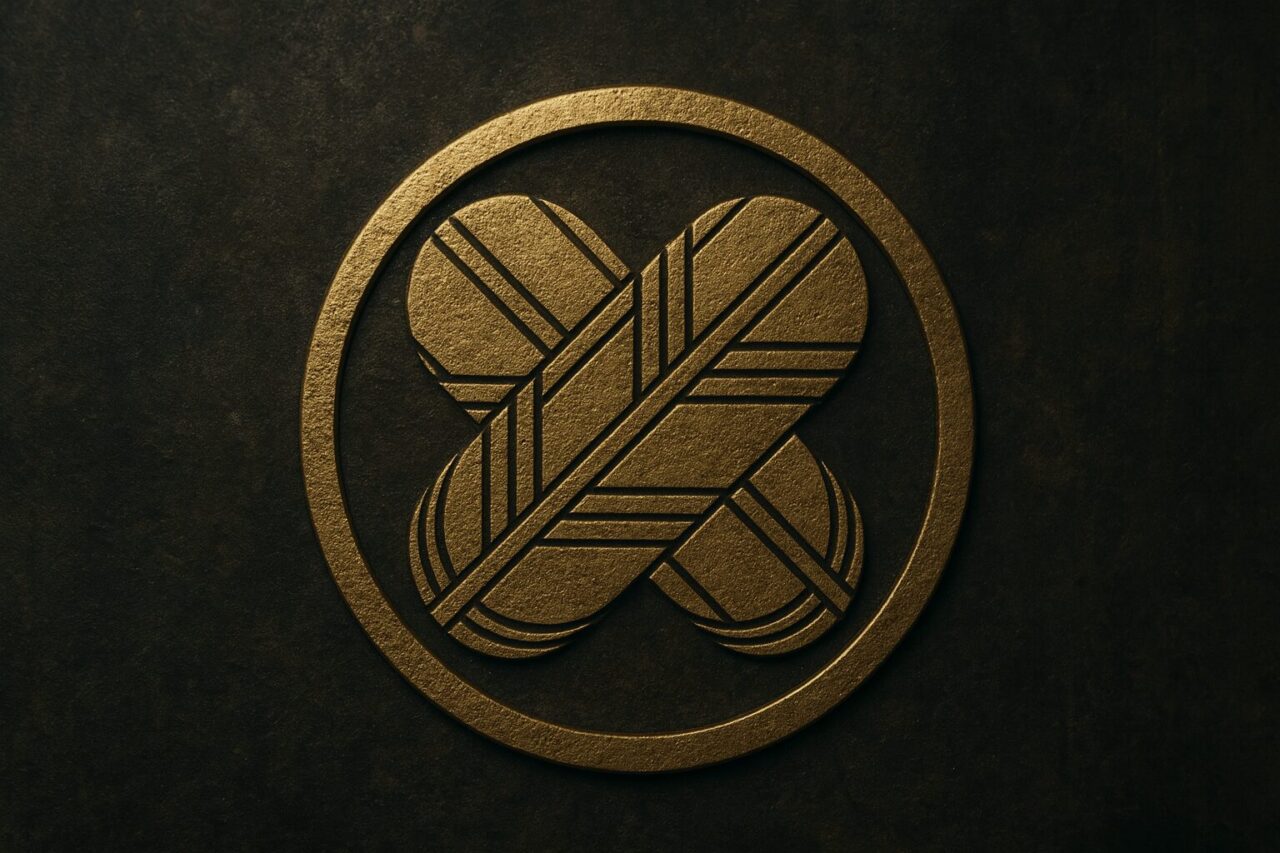
Japanese family crests, known as kamon, represent a symbolic tradition that has been refined over many centuries.
They are not merely decorative patterns; they functioned as visual identifiers of a household, helping people understand lineage, social status, and family roles at a glance.
Kamon have existed for more than a thousand years, evolving in meaning and purpose as Japanese society changed, and they continue to be passed down to the present day.
One of the most distinctive features of kamon is their highly abstract, monochromatic design.
Each crest is reduced to a simple, compact form that can be recognized instantly by anyone who sees it.
While European coats of arms are often colorful and elaborately detailed, Japanese family crests evolved around a different aesthetic—expressing motifs through lines alone and stripping away every unnecessary element.
This approach led to a uniquely minimalist design culture that remains unusual even by global standards.
Although most people no longer think about kamon in their everyday lives, they continue to appear quietly across Japanese culture—in kimono, formal mourning attire, temples and shrines, family registers, commemorative items, and even architectural details.
In recent years, they have also gained renewed attention in creative fields such as graphic design, games, and fashion, where “KAMON” is recognized as a uniquely Japanese visual system and appreciated as a sophisticated design tradition.
In this article, we explore kamon from a comprehensive perspective—covering their meaning, historical development, design structure, legal status, and how they are used in modern life. By examining these elements together, the article aims to offer a deeper understanding of kamon as a uniquely Japanese system of symbolic design.
Japanese family crests developed as identification symbols assigned not to individuals but to entire households.
They served as visual emblems that represented a family’s lineage, history, social role, and values, allowing others to distinguish one household from another at a glance.
A kamon is separate from a family name, and it is common for households sharing the same surname to have completely different crests.
Each crest is inherited along the family line, but it may change over generations—adopted by branch families, altered through marriage, or adjusted to reflect shifts in lineage or household roles.
Kamon function much like modern logos, built from only the minimal lines needed for someone to recognize them instantly.
Shapes such as circles, straight lines, leaves, and flowers are rendered in a simple, unadorned form.
This minimalism developed out of practical necessity: on the battlefield, warriors needed to identify allies and enemies from a distance, making clarity and instant visibility the highest priority in crest design.
In addition, because crests were applied to items such as kimono, furniture, and everyday tools in Japan, they had to remain clear and intact even at very small sizes. This practical requirement further refined their forms, ultimately shaping kamon into one of the most sophisticated examples of minimalist design in Japanese visual culture.
Western heraldic designs typically combine elements such as shields, animals, weapons, crowns, and flags, using rich colors to convey symbolic meaning.
In contrast, Japanese kamon are expressed without color and rely solely on shapes and lines to construct their imagery.
Western designs: multicolored, complex, and layered with symbolic elements
Japanese kamon: monochrome, highly abstract, and reduced to essential forms
These differences stem not only from contrasting cultural backgrounds but also from distinct practical needs.
In Japan, the primary requirement was to create symbols that anyone could recognize instantly, which naturally led to the preference for simple, highly streamlined forms.
European coats of arms were granted to individuals based on personal achievements, military accomplishments, or specific roles, and therefore symbolize the identity of a single person.
In contrast, Japanese kamon were tied to the household, which formed the basic social unit in Japan.
They were inherited across generations through bloodlines and marital connections, reinforcing the continuity and identity of the family rather than the individual.
For this reason, a kamon belongs not to an individual but to the household itself, continuing as long as the family line endures.
This characteristic reflects the structure of the traditional Japanese family system, in which the household—not the individual—served as the central unit of identity and inheritance.
Kamon were not invented by any single person; rather, they took shape gradually over many centuries as Japanese society evolved.
Their development was influenced by three major cultural spheres—the aristocracy, the samurai class, and the common people—each of which contributed to how family crests spread and became established.
The earliest forms of kamon can be traced back to the Heian period (794–1185), when aristocrats decorated ox-drawn carriages and household furnishings with distinctive patterns.
These noble families used such motifs on vehicles, furniture, folding screens, and other items to signify their lineage and social standing.
Over time, these decorative motifs came to be recognized as marks representing a particular household. This gradual shift in meaning laid the foundation for what would eventually develop into the family crest system known as kamon.
One of the major reasons kamon spread rapidly throughout Japanese society was the rise of the samurai class.
On the battlefield, warriors needed a quick way to distinguish allies from enemies, so family crests were displayed prominently on flags, banners, armor, and back-mounted insignia.
This military necessity pushed kamon to evolve into highly simplified symbols designed for maximum visibility. That clarity made them effective in many contexts, helping the use of family crests spread across regions and eventually throughout Japan.
As Japan entered the Edo period(1603–1868), the use of kamon expanded beyond the samurai class and became common among ordinary people.
Because literacy rates were not as high as they are today, visual symbols were often more effective than written characters for conveying information.
In addition, the development of the household system created a growing need for a clear “symbol of the family,” which helped kamon take root in everyday life.
Merchants, craftsmen, farmers, and other social groups increasingly adopted family crests, allowing the practice to spread rapidly across different layers of society.
The appeal of Japanese family crests lies in their extreme abstraction.
Constructed solely from lines without any use of color, these symbols form a uniquely minimalist visual language that stands out even in the global history of graphic design.
Their distilled simplicity is often seen as a direct expression of Japanese aesthetic sensibilities.
Japanese family crests are rendered strictly in black and white, or in subtle variations of tone.
Because color cannot be used, every line and every bit of negative space must be precisely balanced.
This limitation produced an exceptionally refined level of abstraction that defines the aesthetic of kamon.
These constraints became the foundation for a uniquely Japanese aesthetic—one that has no true equivalent in other cultures.
Many kamon are based on familiar motifs such as plants, animals, natural elements, and everyday tools.
However, instead of depicting these motifs realistically, their forms are reduced to essential lines and symbolic outlines, leaving only what is necessary for recognition.
For example, motifs such as paulownia, mandarin orange flowers, wisteria, hawks, ocean waves, and folding fans are commonly used in kamon designs.
In kamon design, circular shapes—referred to simply as maru (“circle”)—appear with remarkable frequency.
The circle carries a range of symbolic meanings, including harmony, continuity, good fortune, and a sense of centered balance.
This “maru-ni–○○” format—literally “a motif placed inside a circle”—is one of the most iconic design structures in kamon and reflects key elements of Japanese aesthetic sensibilities.
Family crests with the same name can still differ slightly from one household to another.
Families often adjusted details—such as line thickness, balance, or the angle of each element—to give the crest a subtle sense of individuality while preserving the original motif.
This flexibility in interpretation has contributed greatly to the richness and diversity of Japanese family crests.
The names of Japanese family crests follow a consistent set of rules.
A crest is typically named in the order of its motif, its variations, its enclosing shapes, and other structural elements—providing clues to how the design is constructed and what it represents.
A family crest is first defined by its primary motif—such as paulownia, mandarin oranges, or wisteria—and then supplemented with additional elements, including component parts, stylistic variations, and enclosing shapes.
This order is followed almost without exception, making it possible to grasp the general appearance of a crest simply by hearing its name.
The commonly seen naming pattern “Maru ni 〜” indicates that the crest is enclosed within a circular frame.
The circle enhances the symbolic presence of the design and serves as a structural frame that brings the entire motif into balance.
Family names and family crests do not necessarily match.
Even households sharing the same surname may have different crests, depending on their region of origin or the lineage from which they descend.
This reflects a social structure unique to Japan, where the household—rather than the individual—served as the fundamental unit of society.
When using family crests, many people wonder how they relate to copyright or trademark law.
It is important to understand whether these designs can be used freely and what legal protections, if any, apply to them.
Traditional family crests are designs that evolved over many centuries, and they are not considered to possess the kind of individual “creative authorship” required for copyright protection.
As a result, the crests themselves are not protected by copyright, and anyone is free to use traditional kamon designs.
Family crests represent a household rather than an individual, so they are not connected to portrait rights or any legal protections tied to personal likeness.
Some companies register trademarks for logos inspired by traditional family crests or designed in a kamon-like style.
In such cases, the trademark does not apply to the original traditional crest itself, but rather to the specific design created by the company.
When kamon-style designs are used overseas in products or artwork, disputes can arise if the design is deemed too similar to an existing corporate logo that has been trademarked in a kamon-like style.
Family crests continue to appear in many aspects of modern life.
They remain embedded in daily customs, ceremonial practices, and traditional culture, preserving their place as a quiet yet enduring part of Japanese identity.
Family crests have long appeared on suits of armor, castle structures, and the buildings of shrines and temples.
They also play an important role in festivals and regional rituals, where crests serve as markers of lineage, community, or historical affiliation.
Family crests are also found on everyday items such as furoshiki wrapping cloths, formal mourning attire, and tea ceremony implements.
Among these, the crest on funeral clothing remains one of the clearest examples of how household crests are still preserved in modern Japanese life.
Gravestones and family genealogies are important places where household crests are preserved in a symbolic form.
They also serve as valuable records for tracing a family’s history and confirming its lineage.
In modern times, kamon-inspired designs are widely used in art, fashion, and even game characters.
These motifs are highly regarded as visually striking symbols that reflect and celebrate Japanese cultural identity.
The continued presence of kamon in modern times is rooted in social structures and aesthetic values unique to Japan.
Throughout Japan’s long history, people were accustomed to conveying information through shapes and symbols rather than written characters.
This cultural familiarity made it natural for family crests to spread and take root across society.
In Japan, a household-centered social structure endured for centuries, and family crests continued to function as symbolic markers of that system.
Japanese artistic traditions—such as tea ceremony, calligraphy, garden design, and Noh theater—are deeply rooted in an appreciation for abstraction, minimalism, and the beauty of empty space.
Family crests can be understood as an extension of this aesthetic sensibility.
The design principles behind kamon align closely with modern minimalist aesthetics, which is one reason they are frequently incorporated into fashion, branding, and logo design today.
Kamon have been gaining recognition internationally in recent years.
One major reason is that their minimalist aesthetic aligns with the global rise of simple, reduction-based design.
The refined underlying structure of kamon makes them valuable references for contemporary logo design and pattern creation. Their clarity, symmetry, and symbolic abstraction continue to inspire many designers in Europe and the United States.
Kamon-inspired motifs are increasingly used in video games and anime characters.
International fashion brands have also begun incorporating kamon-like patterns into their collections, recognizing their strong visual identity and cultural depth.
Kamon embody Japan’s views on family lineage, heritage, and historical continuity.
Because of this cultural significance, they are often embraced as visual symbols of Japanese identity in global media and design.
Kamon represent one of the world’s earliest systematized forms of logo design.
Their long history, structural consistency, and symbolic abstraction have earned them recognition as an important cultural foundation for modern graphic design.
Kamon serve as an essential key to understanding Japanese culture.
Each emblem condenses the concepts of family lineage, historical continuity, aesthetic values, and the social structures that shaped Japanese life.
Few cultures in the world have developed such a structured and enduring system of symbolic design.
As a result, kamon stand as a uniquely Japanese form of cultural heritage—an unparalleled legacy of visual symbolism.
The abstract forms and structural beauty of kamon carry a universality that resonates with modern design and cultural studies.
Though deeply traditional, they remain a flexible cultural resource—one that can be seamlessly applied to future design practices.