Japanese Karaage Culture | The Balance and Beauty of Everyday Flavor
CoCoRo編集部
CoCoRo

Japanese New Year is not simply a celebration of the calendar changing.
It is a time to welcome a new year, prepare the home, receive a deity, share food with family, visit shrines and temples, and shift the mind from the old year into the new one.
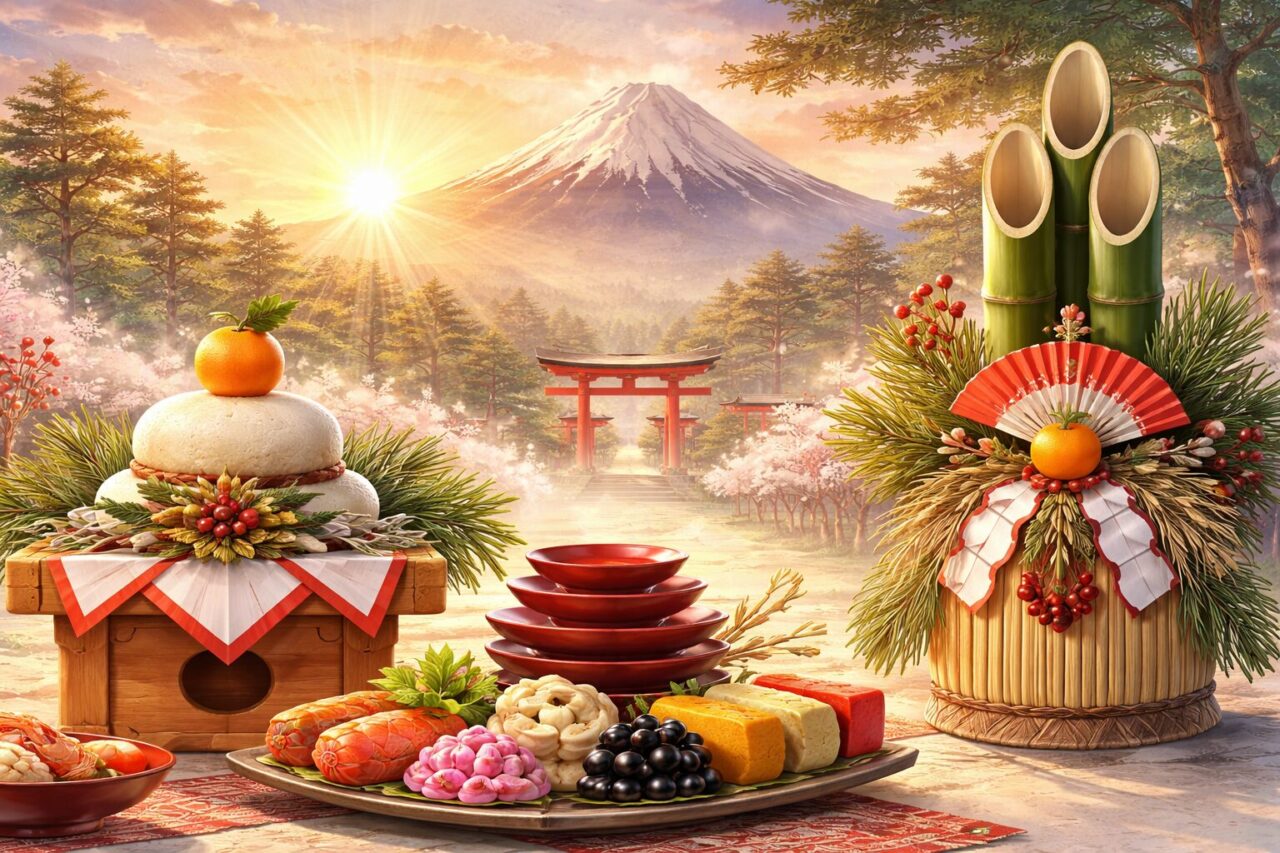
Kadomatsu pine decorations, shimekazari sacred rope ornaments, kagami mochi rice cakes, ozoni soup, osechi dishes, hatsumode shrine visits, and the first sunrise of the year are all familiar parts of New Year in Japan. Behind them, however, are many layers of culture: belief in Toshigami, ancestor worship, rice farming, court rituals, shrine and temple visits, and even modern transportation culture.
That is why Japanese New Year can feel slightly mysterious.
It is a quiet family-centered season, yet huge crowds gather at shrines and temples. It can look religious, yet many people experience it as part of ordinary life. It comes from old beliefs, yet it still fits naturally into modern Japanese living.
This article explains what Japanese New Year culture is, when it began, the meaning of Toshigami and New Year decorations, how hatsumode became widespread, and how people overseas often react to Japan’s quiet and symbolic way of welcoming the year.
Shogatsu, or Japanese New Year, was originally a period for welcoming the deity of the new year.
In Japanese folk belief, the deity who visits the home at New Year has been called Toshigami, Toshigami-sama, Shogatsu-sama, and other regional names. Toshigami is believed to bring the vitality, harvest, and happiness of the coming year. In some regions, this deity has also been connected with ancestral spirits and the god of the rice fields.
In other words, Japanese New Year is not just the day when the calendar changes to January 1.
It was a turning point for welcoming a divine presence into the home, receiving the power of the new year, and resetting the life of the family and community. Cleaning the house, putting up New Year decorations, offering mochi, and eating with family were not only preparations for the holiday. They were also preparations for receiving Toshigami.
Today, many people no longer consciously think about Toshigami. Even so, the feeling remains: people clean at the end of the year, eat special New Year foods, and visit a shrine or temple to pray for safety and good fortune.
Japanese New Year culture continues even when the explicit belief has faded, because the deeper sense of “preparing oneself to receive a new year” still remains.
It is difficult to say that Japanese New Year culture began in one specific period.
However, the ideas behind it are deeply connected to ancient farming culture and ancestor worship. In a society centered on rice cultivation, the beginning of the year was not just a date. It was an important turning point for wishing for the next harvest and the prosperity of the household.
This is why Toshigami has often been spoken of in connection with both the rice-field deity and ancestral spirits.
The rice-field deity brings agricultural fertility. Ancestral spirits protect the home and watch over descendants. Toshigami, welcomed at New Year, came to be understood as a presence that carried both of these meanings.
Welcoming the new year was not only about time passing. It was a ritual for removing the impurity and weariness of the old year, restoring strength to the household, and beginning the next year in a renewed state.
Once you understand this, it becomes easier to see why the home matters so much during Japanese New Year. Originally, New Year was less an outdoor festival and more a household ritual for receiving a deity. Cleaning the house, setting up decorations, and eating with family were central because the home itself was the place where the new year was welcomed.
New Year is not a culture found only in Japan.
Across East Asia, there are traditions that celebrate the lunar new year, including Chinese New Year, Seollal in Korea, and Tet in Vietnam. These cultures share important themes: families gather, ancestors are honored, and people wish for happiness in the year ahead.
Japanese New Year, however, has one major feature that sets it apart.
After the Meiji period (1868-1912), Japan adopted January 1 of the solar calendar as the main New Year date. In much of Japan today, New Year events are centered on January 1 of the modern calendar rather than the traditional lunar new year.
Of course, Japan still has customs related to the lunar new year and Koshogatsu, or Little New Year. In Okinawa and some other regions, older lunar calendar customs remain important. Still, on a national level, the combination of January 1, Toshigami belief, New Year decorations, mochi, ozoni, and hatsumode has become the widely recognized shape of Japanese New Year.
Chinese New Year is often associated with large-scale public celebration, travel, firecrackers, red decorations, and a lively atmosphere. Japanese New Year, by contrast, often leaves a stronger impression of quiet homes, shrine and temple visits, and foods filled with symbolic meaning.
Both are New Year cultures, but Japanese New Year has developed its own form as a quiet household-centered event for welcoming a deity and beginning the year in a settled state.
Japanese New Year decorations are not only meant to make the home look festive.
Originally, they served as signs and offerings for welcoming Toshigami.
Kadomatsu are New Year decorations placed at the gate or entrance of a home.
Pine trees remain green even in winter, so they have long been valued as symbols of vitality and longevity. Bamboo is also often included. Together, these plants are understood as decorations that welcome the energy of the new year.
Kadomatsu were believed to serve as markers showing where Toshigami should descend.
They were not just ornaments. They were a way of preparing the entrance of the home and saying, in effect, “This is a house ready to welcome the New Year deity.”
Shimekazari are sacred rope decorations often placed at the entrance of the home.
Shimenawa ropes are used to separate sacred space from ordinary space. The same idea can be seen at Shinto shrines, where shimenawa mark places that are considered pure or sacred.
Placing shimekazari at the entrance during New Year means purifying the home and preparing it as a place suitable for welcoming Toshigami.
This is closely connected with year-end cleaning. First the home is cleaned. Then the entrance is marked as a purified place. Only after that is the New Year welcomed. What may look like a formal custom today once had a very clear meaning.
Kagami mochi are round rice cakes offered during New Year.
Mochi is rice transformed into a special form. Unlike everyday cooked rice, mochi has been treated as a food for offerings, celebration, and spiritual strength.
Kagami mochi are offerings to Toshigami and were also understood as a vessel in which the deity could dwell. Their round shape is often associated with old bronze mirrors, which were regarded as sacred objects.
To understand Japanese New Year more deeply, it helps to see mochi not only as food, but as a symbolic form of rice, blessing, and renewed strength.
Food plays a central role in Japanese New Year culture.
Special New Year dishes are not only about eating something luxurious. They express the wish to receive the strength of the new year, pray for family health, and taste ingredients with auspicious meanings. New Year food is, in a sense, a ritual that is eaten.
Ozoni is a New Year soup centered on mochi.
Its form varies greatly by region. Some areas use round mochi, while others use square mochi. Some make it with white miso, others with clear broth. Regional examples include Kyoto-style white miso ozoni, clear soup in the Kanto region, sweet red bean mochi ozoni in Kagawa, and yellowtail ozoni in parts of northern Kyushu.
Behind ozoni is the idea of sharing mochi that has been offered to Toshigami. Mochi was an offering to the New Year deity, and eating it meant taking the power of the new year into the body.
This is why ozoni is more than a soup. It is one of the clearest examples of how Japanese New Year turns belief into food.
Osechi ryori is a set of auspicious New Year dishes arranged in tiered boxes.
Black soybeans, herring roe, candied chestnuts, rolled kelp, and other dishes each carry meanings such as health, fertility, good harvest, joy, and prosperity.
At the same time, osechi also helped families spend several days at home during the New Year period. Cooking was reduced, the kitchen could rest, and the family could share the same prepared dishes together. These practical household needs also shaped osechi.
From an overseas perspective, it can be surprising that cold dishes are arranged in boxes and eaten over several days. Yet once the meanings are understood, each dish begins to look less like a preserved meal and more like a wish for the new year made visible through food.
Otoso is a medicinal sake-based drink consumed at New Year.
It is often skipped today, but it was once accepted as a New Year custom for warding off misfortune and praying for health. Because it is made by steeping medicinal herbs in sake or mirin, it is not simply a celebratory drink. It also carries the feeling of medicine.
In modern households, however, some people feel unsure about its meaning or find it difficult to serve because it contains alcohol. This is one reason otoso now remains more as a cultural memory in many homes than as a daily practice.
Hatsumode is now one of the most familiar parts of Japanese New Year.
Many people visit a shrine or temple at the beginning of the year to pray for health, happiness, and good fortune. For many Japanese people, this feels natural. However, hatsumode did not always exist in its current form.
Originally, New Year centered on welcoming Toshigami into the home. Preparing the house, offering mochi, and beginning the year with family were the core elements.
At the same time, customs of visiting local guardian shrines or temples at the beginning of the year also existed. One older practice was to stay overnight at the local shrine from New Year’s Eve into New Year’s Day, a custom connected with welcoming the new year. Another idea involved visiting a shrine or temple in the lucky direction of the year, known as eho.
Over time, these practices changed. After the Meiji period (1868-1912), the growth of railways and urban life helped spread the modern form of hatsumode: visiting a famous shrine or temple at the start of the year.
So hatsumode cannot be explained only as an ancient religious custom.
The modern practice was shaped by household New Year rituals, local guardian deity worship, shrine and temple visits, and modern transportation culture.
When people from overseas see Japanese New Year, several things can feel surprising.
However, if this topic is treated only as a list of travel impressions, it can drift away from the deeper meaning of New Year culture. Here, the point is to use overseas reactions as a way to understand what makes Japanese New Year distinctive.
In many countries, New Year is welcomed with countdowns, fireworks, music, and parties.
By contrast, New Year’s Eve in Japan can feel surprisingly quiet. Some cities do have countdown events, but the cultural center of the season is often calmer: staying at home, eating toshikoshi soba, and listening to joya no kane, the temple bells rung on New Year’s Eve.
Joya no kane is not simply a sound event. It is connected with the idea of clearing away the passions and attachments of the old year and welcoming the new year with a purified mind.
To visitors from overseas, this quietness may not feel like a lack of celebration. It can feel more like Japan is beginning the year by settling itself rather than by making noise.
Hatsumode also leaves a strong impression on visitors from overseas.
Large numbers of people go to shrines and temples, wait in line, offer coins, put their hands together, receive omamori amulets, and draw omikuji fortunes. It can look religious, yet for many people it is not necessarily a strong declaration of faith.
This ambiguity is part of what makes hatsumode feel distinctly Japanese.
For many Japanese people, hatsumode is less about carefully separating Shinto and Buddhism and more about “properly visiting at the start of the year.” The prayers are often close to daily life: passing exams, good health, family safety, business prosperity, or good relationships.
From an overseas perspective, it can feel fresh that religion and daily life are not sharply separated, that prayer is quiet and personal, and that even large crowds often keep a calm atmosphere.
Japanese New Year foods and decorations are full of meaning.
Osechi dishes carry auspicious messages. Ozoni reflects the idea of eating mochi offered to Toshigami. Kadomatsu, shimekazari, and kagami mochi are part of the preparation for welcoming the New Year deity.
What surprises people overseas is not only the unfamiliar appearance.
Why put decorations at the entrance? Why offer mochi? Why eat cold dishes arranged in tiered boxes? When each of these acts has meaning, Japanese New Year begins to feel like a culture with unusual depth.
Otoshidama, the custom of giving money to children at New Year, is also interesting to many people overseas.
The custom of giving money to children exists in other parts of East Asia as well. In Japan, however, otoshidama is distinctive because it is usually placed in small decorative envelopes and is closely tied to gatherings with relatives.
The year-end and New Year travel rush also shows how strongly the season is centered on family.
Compared with cultures where New Year is mainly celebrated with friends at parties, Japanese New Year makes family, relatives, the family home, ancestors, and local ties more visible. This is one reason the season is often perceived as quiet, solemn, and inward-looking.
Watching the first sunrise of the year is another familiar Japanese New Year practice.
The sight of the sun rising is beautiful in any country. In Japan, however, the sunrise on the morning of January 1 has taken on special meaning.
If Toshigami is understood as the deity who brings the power of the new year, then the first sunrise can be seen as a way of witnessing that beginning with one’s own eyes. People gather by the sea, on mountains, or at viewpoints to watch the morning sun and wish for safety in the year ahead. This combines reverence for nature with the desire to physically feel the start of the year.
Today, many people enjoy the first sunrise as a sightseeing event. Even so, the fact that many people watch it quietly rather than loudly celebrating is connected to the broader Japanese New Year feeling of settling and preparing oneself.
To understand Japanese New Year, it is also useful to compare it with Obon.
Obon is known as a summer event for welcoming and honoring ancestral spirits. New Year, on the other hand, is a time for welcoming Toshigami, and in some regions Toshigami has been understood in connection with ancestral spirits.
For this reason, Obon and New Year are different events, yet both can be seen as customs for welcoming a presence into the home.
Obon welcomes ancestors in summer. New Year welcomes Toshigami in winter.
Both involve preparing the home, offering food, and gathering with family. Even though many people today do not strongly think about the religious meaning, the feeling that “Obon is a time to return home” and “New Year is a time to go back to the family home” remains. That feeling is connected to the household-centered structure of both events.
In modern Japan, the way people spend New Year has changed greatly.
Some families buy osechi instead of making it. Some homes do not put up kadomatsu. Kagami mochi may be a small store-bought item. Some people do not go to hatsumode. More shops stay open during the New Year period, and the feeling that the whole town shuts down has weakened.
Even so, Japanese New Year culture has not disappeared.
That is because New Year is not only a ritual that people are required to perform. It is also tied to the feeling of marking a boundary in time.
Cleaning at the end of the year changes the mood. Eating mochi or ozoni makes the year feel new. Putting one’s hands together at hatsumode gives a sense that the year has begun. Going back to the family home can make one’s place in life feel a little more settled.
These feelings remain even when people do not know the old beliefs in detail.
Japanese New Year culture continues by changing its form. It remains a habit through which people in Japan reset their sense of time and begin again.
It is difficult to identify one exact starting point for Japanese New Year culture. Its background includes ancient farming culture, ancestor worship, and belief in Toshigami, all of which developed in connection with rice cultivation and household faith.
New Year celebrations are not unique to Japan. Chinese New Year, Korean Seollal, Vietnamese Tet, and other East Asian traditions also celebrate the new year. What is distinctive in Japan is the modern combination of January 1, Toshigami belief, New Year decorations, ozoni, and hatsumode.
Japanese New Year includes the meaning of welcoming Toshigami and wishing for harvest, happiness, and safety in the new year. Its culture combines Shinto elements, ancestor worship, farming beliefs, Buddhist practices, and shrine and temple visits, so it cannot be explained through only one religion.
The custom of visiting shrines and temples at the beginning of the year has old roots. However, the modern form of hatsumode, in which many people visit famous shrines and temples at New Year, became widespread after the Meiji period (1868-1912), along with urban life and railway development.
Many people overseas see Japanese New Year as quiet, solemn, and family-centered. Instead of loud countdowns or parties, they notice the calm atmosphere, shrine and temple visits, meaningful foods, and symbolic decorations used to welcome the year.
Japanese New Year culture is not simply a celebration of a new calendar year.
It brings together belief in Toshigami, ideas about ancestors and rice-field deities, the meaning of mochi and ozoni, the role of kadomatsu and shimekazari, and the custom of visiting shrines and temples. Household rituals, local belief, shrine and temple culture, and modern life all overlap within it.
That is why Japanese New Year can be quiet yet crowded, religious yet everyday, old yet still present in modern life.
When you understand the meaning of New Year, kagami mochi, ozoni, and hatsumode begin to look a little different.
Japanese New Year is a culture for preparing the home and the heart to welcome a new year.