Japan Winter Food Guide | Christmas to New Year Seasonal Eats
CoCoRo編集部
CoCoRo

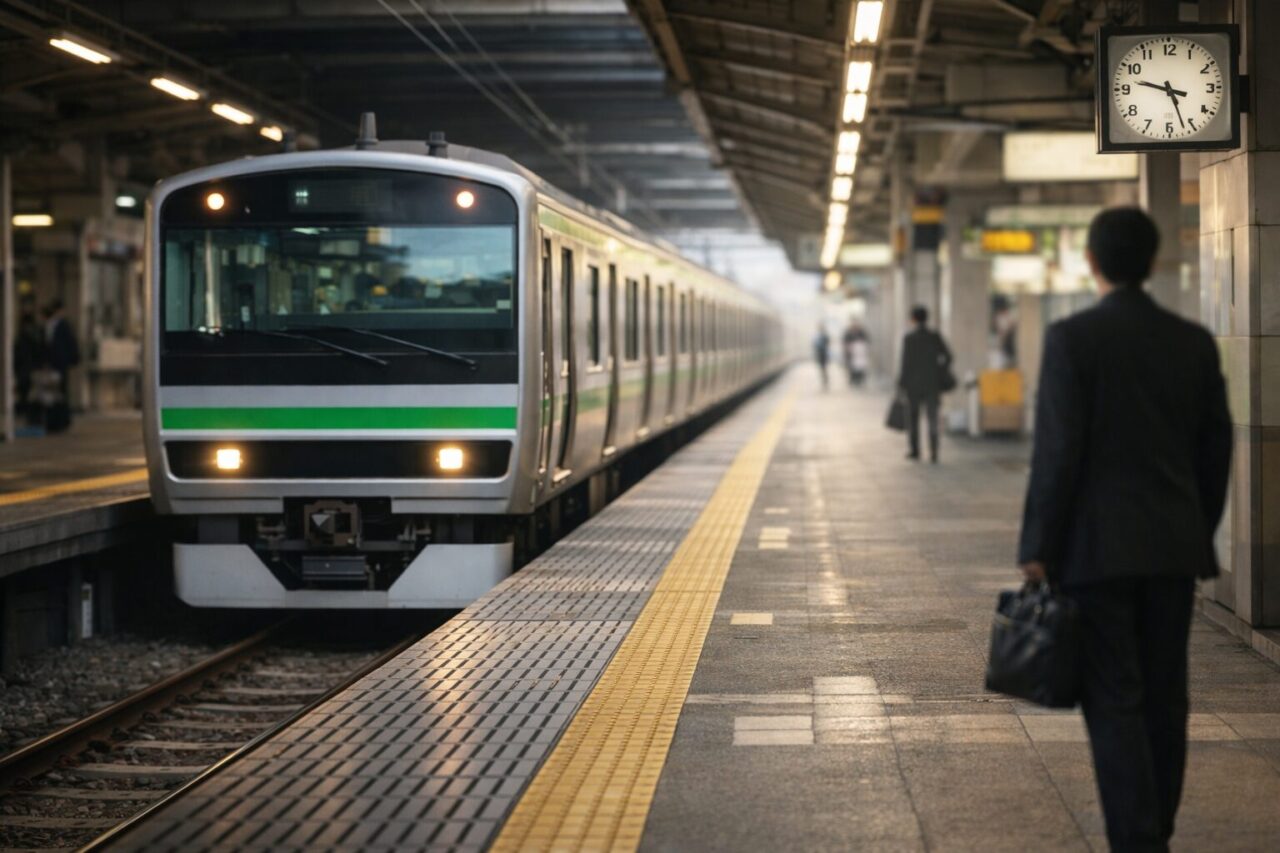
For many visitors, one of the first signs that daily life in Japan works differently appears on a station platform. A train arrives at the time shown on the board, hundreds of passengers get on and off within moments, and the doors close without the platform descending into chaos.
Japanese trains are not literally never late. Bad weather, earthquakes, accidents, technical failures, and crowded platforms can all disrupt service. Japan also does not publish one nationwide punctuality rate covering every railway under a single definition.
Even so, the performance of its busiest lines is remarkable. In fiscal 2024, the Tokaido Shinkansen recorded an average delay of just 1.4 minutes per train—including delays caused by natural disasters—while operating an average of 383 trains and carrying about 460,000 passengers per day.
That level of reliability cannot be explained simply by saying that Japanese people are punctual. It is produced by a complete system: dense timetables, railway technology, trained staff, station design, passenger cooperation, and cities that have grown around dependable rail travel.
Japanese trains are often described as the world’s most punctual. The description feels believable to travelers, but a precise global ranking is difficult to produce.
There is no current official ranking that measures every country’s railways under the same conditions. Railway operators do not even use the same definition of “on time.” A train may count as punctual when it arrives less than three minutes late in one system, less than five minutes late in another, and as much as 10 or 15 minutes late on some long-distance services.
Statistics can also measure different things. Some count arrival at every recorded station, while others focus on the final destination. Canceled trains may be included, excluded, or reported separately. A national network, an urban metro, and a dedicated high-speed line are not directly comparable.
This means that “Japan ranks number one” is not a clean statistical conclusion. It does not mean the reputation is unfounded. Comparing Japan’s actual performance with the thresholds used elsewhere shows why its railways are widely regarded as exceptionally precise.
The table below places one representative Japanese result beside punctuality thresholds used in European passenger rail statistics. The figures are not the same type of measurement: Japan’s 1.4 minutes is an actual annual average delay, while the European figures show how much delay may still be classified as punctual.
| Country or region | Service measured | Published figure | What the figure means |
|---|---|---|---|
| Japan | Tokaido Shinkansen | Average delay: 1.4 minutes per train | FY2024 result, including delays caused by natural disasters |
| England and Wales | Arrival at recorded stations | Under 3 minutes | Threshold for an on-time arrival |
| Austria | Passenger trains | Within 5 min 29 sec | Punctuality threshold |
| Czechia | Passenger trains | Within 5 minutes | Punctuality threshold |
| Denmark | Passenger trains | Within 3 minutes | Punctuality threshold |
| Finland | Commuter and urban rail | Within 3 minutes | Punctuality threshold |
| Finland | Long-distance trains | Within 5 minutes | Punctuality threshold |
| France | Passenger trains | Within 5 minutes | Punctuality threshold |
| Germany | Passenger trains | Within 5 min 59 sec | Punctuality threshold |
| Greece | Short-distance trains | Within 5 minutes | Punctuality threshold |
| Greece | Long-distance trains | Within 15 minutes | Punctuality threshold |
| Ireland | Short-distance services | Within 5 minutes | Punctuality threshold |
| Ireland | Long-distance services | Within 10 minutes | Punctuality threshold |
| Italy | Passenger trains | Within 5 minutes | Punctuality threshold |
| Luxembourg | Passenger trains | Within 6 minutes | Punctuality threshold |
| Netherlands | Passenger trains | Within 3 or 5 minutes | More than one threshold is used |
| Norway | Local, intercity, and airport trains | Within 3 min 59 sec | Punctuality threshold |
| Norway | Long-distance and international trains | Within 5 min 59 sec | Punctuality threshold |
| Portugal | Suburban trains | Within 3 minutes | Punctuality threshold |
| Portugal | Other passenger trains | Within 5 or 10 minutes | More than one threshold is used |
| Romania | Passenger trains | Within 20 minutes | Punctuality threshold |
| Slovakia | Passenger trains | Within 5 minutes | Punctuality threshold |
Across much of Europe, a delay of around three to five minutes can still fall within an on-time category. Longer tolerances may apply to long-distance trains. By contrast, the Tokaido Shinkansen’s actual average delay in FY2024 was 1.4 minutes.
The comparison is not a league table, but it makes the practical difference easy to understand: the average Shinkansen delay was shorter than the margin many railway systems allow before a train is classified as late.
Sources: Office of Rail and Road, “CP7 passenger train performance reset”; Central Japan Railway Company, Fact Sheets 2025
An average delay is more meaningful when it is considered alongside the scale and intensity of the operation.
| Measure | FY2024 figure | Scope | Why it matters |
|---|---|---|---|
| Average delay per train | 1.4 minutes | Includes delays caused by natural disasters | The annual average remained in the one-minute range, not only under ideal conditions |
| Trains per day | 383 | Daily average including extra services | Punctuality is maintained across a high-frequency operation |
| Passengers per day | About 460,000 | Daily average on the Tokaido Shinkansen | Reliability is achieved while moving a very large number of people |
| Maximum trains per hour | 18 | Maximum operating frequency | Equivalent to one train about every 3 minutes 20 seconds at peak capacity |
| Seats per train | 1,314 or 1,318 | Depends on the trainset | Each service can carry more than 1,300 seated passengers |
| Maximum operating speed | 285 km/h | Commercial operating speed | Speed, frequency, capacity, and precision are delivered together |
The impressive point is not simply that one train arrives on time. It is that a high-speed railway can run hundreds of services and carry nearly half a million passengers a day while keeping the average delay extremely small.
Most travelers do not examine annual railway statistics before visiting Japan. They experience punctuality through repeated, ordinary moments.
A departure board can be used to plan a connection with confidence. A train that is several minutes late may trigger an announcement and an apology. At major stations, Shinkansen services arrive, unload, board, and depart in rapid succession. In Tokyo and Osaka, enormous rush-hour crowds still move according to recognizable boarding patterns.
The predictability is often more memorable than raw speed. A visitor can plan sightseeing, restaurant reservations, or a transfer to another city around an advertised arrival time and reasonably expect the plan to work.
In many Japanese cities, passengers build their journeys around tight connections. Railways are so dependable that a small delay becomes visible: it may affect another train, the start of work or school, or an appointment at the destination.
An apology for a short delay does not mean that every passenger is furious about losing two minutes. It reflects the fact that the published timetable is treated as a shared promise. The more reliable the service becomes, the more clearly an exception stands out.
Visitors also remember how quiet many commuter trains can be. Phone calls are generally avoided, music is kept inside headphones, and loud conversation is uncommon. Punctuality, cleanliness, and quietness combine into one impression of an orderly railway environment.
For a closer look at the social expectations behind this experience, see Why Are Japanese Trains So Quiet?
In 2017, a Tsukuba Express train departed Minami-Nagareyama Station 20 seconds before its scheduled time. The operator apologized even though it reported no complaints from passengers.
The story attracted international attention because the train had not been late. Yet an early departure can be more harmful than a small delay. A passenger who reaches the platform before the published departure time should still be able to board. If the train has already left, the timetable can no longer be trusted.
Japanese railway regulations prohibit trains from departing before the scheduled time. The concern is therefore not an obsession with making every clock display match to the second. It is the practical promise that a service will remain available until its stated departure time.
When disruption occurs, Japanese railway companies may issue delay certificates that passengers can show to an employer or school. The qualifying delay and method of issue vary by operator and line; some companies make certificates available online when delays reach five minutes or more.
The certificate does not make a late train punctual. It provides a shared way to distinguish a transport disruption from a passenger simply arriving late. Its existence shows how strongly work and school schedules rely on railway time.
The passenger timetable displays minutes, but the working railway schedule is much more detailed. A diagram plots stations against time and traces each train as a line across the network. During busy periods, those lines are packed so closely together that the chart can look like the blueprint of a machine.
Planners must coordinate running time, station dwell time, turnarounds, passing movements, connections, crew assignments, and space for recovery. In a dense network, one longer-than-planned stop can prevent the following train from entering a station. The delay can then spread through the line.
Precision does not come from removing every second of spare time. A workable timetable also needs margins that prevent a small disturbance from becoming a network-wide failure.
In metropolitan areas, one train may continue directly from one company’s line onto another. This through-service saves passengers from changing trains, but it also connects the operational risks of multiple networks.
A disruption on one line can affect a service many kilometers away. Control centers, station staff, drivers, and different railway companies must share information and adjust destinations, train order, connections, and cancellations. Maintaining punctuality therefore depends on coordination across organizations, not only on the performance of an individual driver.
Japanese railway punctuality is supported by many systems that passengers rarely notice.
Train control and signaling maintain safe separation between services. Drivers combine precise acceleration, braking, and stopping with information from signals and operating systems. Accurate stopping positions are especially important at stations with platform screen doors.
Automatic ticket gates, IC cards, marked boarding positions, stairs, and passageways also matter. If passenger flow stops at the gate or platform, boarding takes longer and the train cannot keep its planned dwell time.
Staff training is another part of the system. Drivers, conductors, station employees, control-center personnel, and maintenance teams repeatedly practice routine checks and emergency procedures. During an incident, safety comes before the timetable. The operational challenge is to protect passengers, understand the problem, and restore the wider network without allowing disruption to spread unnecessarily.
Japan’s earthquakes, typhoons, heavy rain, and snow make this especially important. Stopping a train during dangerous conditions is not a failure of punctuality. Reliable transportation includes knowing when not to run and how to inspect and reopen the line safely.
Even a perfectly designed timetable becomes unstable if boarding takes an unpredictable amount of time at every station.
At many Japanese stations, passengers wait beside markings that show where the doors will stop. They allow people to leave the train before boarding and prepare tickets or IC cards before reaching a gate. Each action saves only a small amount of time, but repeated across hundreds or thousands of passengers, it makes station dwell times more predictable.
The custom is not unique to trains. If you want to understand why orderly lines are so common in everyday Japanese life, read Why Do People Queue in Japan?
Railway reliability and passenger behavior reinforce each other. Because trains are usually punctual, people trust the timetable and arrive at the platform accordingly. Because many passengers follow the expected boarding flow, operators can build short and consistent station stops into the schedule.
Japan did not always live by minute-by-minute clock time. During the Edo period, time was commonly divided using a seasonal system in which the length of temporal hours changed through the year. Modern standardized time spread with the institutions of the Meiji era, including railways, schools, and factories.
Railways required distant places to share a clock. A train could not leave whenever enough passengers had gathered; it had to depart according to a published schedule. As urbanization and commuting expanded after World War II, planning daily life by the minute became increasingly normal.
Geography also helped make railways essential. Much of Japan is mountainous, and large populations became concentrated in limited areas of usable land. Dense cities such as Tokyo, Osaka, and Nagoya needed to move huge numbers of people through narrow urban corridors.
Private railway companies did more than connect existing communities. Operators such as Hankyu and Tokyu developed housing, department stores, schools, and leisure facilities along their lines. They helped create a lifestyle in which commuting, shopping, and entertainment revolved around railway stations.
As more people depended on trains, frequency and reliability became more valuable. Better service attracted more passengers, while larger passenger numbers justified further investment. Punctuality became both a customer expectation and a condition for keeping dense cities moving.
The answer is not that railway employees elsewhere care less about time.
Networks operate under different conditions. A dedicated high-speed line does not face the same constraints as a long-distance route shared by passenger and freight trains. Older infrastructure may require more engineering work. International services cross operational boundaries. Longer journeys encounter more weather, connections, and opportunities for disruption.
Countries also make different choices about frequency, resilience, staffing, investment, and the amount of spare capacity available. A system may prioritize broad geographic coverage or lower operating cost rather than running trains every few minutes.
The published statistics then apply different delay thresholds and treatment of cancellations. This is why a simple country ranking can hide more than it explains.
Japan’s achievement is best understood in context: its largest urban areas depend heavily on rail, operators have developed systems for high-frequency movement, and passengers expect the timetable to be dependable. Technology, investment, work practices, and social habits have evolved together.
Japanese local buses also follow detailed timetables, and drivers generally avoid leaving a stop before the scheduled time. As with trains, an early departure could strand a passenger who arrived when the timetable said the bus would still be there.
Buses, however, operate on public roads. Traffic, construction, accidents, weather, and the number of passengers paying or boarding can all affect arrival times. They therefore cannot consistently match the precision of a railway running on controlled tracks.
The timetable is still taken seriously. Drivers know the recurring traffic patterns of their routes, and operators use scheduling and real-time information to bring services as close to the published time as road conditions allow.
There is no single worldwide railway ranking that proves Japan is statistically number one under identical conditions. But the absence of that ranking should not obscure what travelers experience or what operating data shows.
In FY2024, the Tokaido Shinkansen averaged a delay of only 1.4 minutes per train while running 383 trains and carrying about 460,000 passengers per day. That performance sits below the three-to-five-minute margins commonly used to classify trains as punctual in many European systems.
Japanese trains run so reliably because precision is built into the entire journey: the timetable, signaling, trains, stations, trained staff, disruption management, passenger flow, and the expectations of people who organize their days around rail travel.
It is not simply “Japanese personality,” and it is not technology acting alone. Reliability is recreated every day by a network of people and systems that depend on one another.
For some travelers, the contrast becomes clearest only after they return home and begin missing the predictable journeys and quiet carriages. That feeling is explored in Why Do People Experience JPSD After Visiting Japan?
No. Japanese trains can be delayed by severe weather, earthquakes, accidents, technical problems, passenger emergencies, and congestion. They are exceptionally reliable, but they are not immune to disruption.
There is no current official global ranking that measures every railway with one definition. However, the Tokaido Shinkansen’s FY2024 average delay of 1.4 minutes per train shows that major Japanese rail services operate at a world-class level of precision.
Japan has no single nationwide punctuality threshold covering every railway. The criteria used for service notices and delay certificates vary by operator and line.
Central Japan Railway Company reported an average delay of 1.4 minutes per train in fiscal 2024, including delays caused by natural disasters.
Passengers rely on the published timetable for connections, work, school, and appointments. Because normal service is highly predictable, even a small disruption can affect plans and is treated as information the operator should explain.
An early departure can prevent passengers who arrive by the published time from boarding. Japanese railway regulations prohibit departure before the scheduled time.
Detailed timetables, signaling and train-control systems, trained staff, efficient station design, disruption planning, and predictable passenger boarding all work together. Japan’s dense cities and heavy dependence on rail also make precise operation essential.
Operators aim to follow their timetables and avoid early departures, but buses are more vulnerable than trains to traffic, roadworks, accidents, and weather. They may therefore arrive late even when the service is carefully managed.