What Is Japanese Iced Coffee? Flash Brew, Cold Brew Differences, History, and Foreign Reactions
CoCoRo編集部
CoCoRo

If you are planning to eat sushi in Japan, it is easy to assume that you should search for the most expensive omakase you can afford.
That is not always the most enjoyable way to begin.
Japan has excellent sushi at several levels: nationwide casual chains, regional conveyor-belt restaurants, independent shops in seafood regions, and high-end counters in major cities. They are not simply cheaper and more expensive versions of the same meal. Each creates value in a different place—from speed and consistency to local fish, skilled preparation, distribution and the chef’s judgment.
Our suggestion is simple: start at a level you can understand and enjoy, then move upward if sushi captures your interest. Eating casual sushi first gives you a reference point. When you later try rice shaped by hand, local seasonal fish, freshly grated wasabi or an omakase course, you can actually notice what changed.
This guide explains Japan’s casual kaiten-zushi culture, the difference between machine-shaped and chef-shaped rice, four practical sushi experiences, and how to choose your next restaurant according to your experience and destination.
Japan has a casual restaurant format called kaiten-zushi, commonly translated as “conveyor-belt sushi.”
Traditionally, small plates of sushi moved around the dining room on a conveyor belt. Customers watched the plates pass, took whatever looked appealing and paid according to the number or color of the plates.
Today, the sushi may not literally circle the room. Many restaurants use a touchscreen: you place an order, and a dedicated lane delivers the plate directly to your seat. The format is still called kaiten-zushi because it retains the same basic role—affordable sushi served quickly, one plate at a time, in a setting where customers can choose freely.
This is not a lesser-known tourist novelty. It is an ordinary part of Japanese life. Families visit, office workers stop for lunch, and groups can order according to different tastes and appetites.
Major casual chains are especially approachable for first-time visitors because they usually offer:
Japan’s sushi robots also helped make sushi widely affordable. The world’s first automated machine for shaping portions of sushi rice was launched in 1981, following years of development intended to reproduce a parcel that holds together but still breaks apart softly in the mouth. Sushi robots are now used internationally.[^1]
For a casual meal, this combination of automation, temperature control, purchasing power and standardized preparation can produce sushi of impressive consistency.
If someone in Japan says, “I’ll treat you to sushi,” the other person may jokingly ask:
“The kind that doesn’t go around?”
The question sounds as if it is about restaurant machinery. It is really a question about how special the meal will be.
In everyday Japanese conversation, “sushi that goes around” suggests a casual, affordable restaurant. “Sushi that does not go around” suggests a chef, a counter, a higher bill and a more special occasion.
It is not a formal rule. Some excellent restaurants deliver sushi on a lane, and some restaurants without a belt are modest neighborhood shops. Yet the joke works because Japanese people broadly share the distinction between everyday conveyor-belt sushi and a meal prepared piece by piece by a sushi chef.
That distinction is useful for visitors—but only as a starting point.
A conveyor belt tells you how the sushi reaches the customer. It does not necessarily tell you who prepared it.
At high-volume chains, much of the process may be standardized. A machine can shape uniform portions of rice, prepared toppings can be placed on them, and the restaurant can serve large numbers of customers quickly.
At some regional conveyor-belt restaurants, however, chefs cut fish in the restaurant and prepare orders by hand. The finished sushi may be placed on a lane or handed directly to the customer. These restaurants combine the convenience of kaiten-zushi with elements normally associated with an independent sushi shop.
This distinction matters because a traveler should not use the presence of a conveyor belt as the only measure of quality.
When evaluating a sushi restaurant in Japan, consider three separate questions:
The answers do not always fall into neat pairs.
The easiest comparison is not between a conveyor belt and a counter. It is between a standardized McDonald’s burger and a burger made individually at a serious specialist restaurant.
McDonald’s can be enjoyable. Its strengths are consistency, speed, accessibility and price. A specialist burger restaurant has a different goal. The cook can adjust the meat, heat, seasoning, bun and assembly for each order. If the only question is how good one burger can become, the specialist restaurant has the higher ceiling.
Sushi rice works in a similar way.
A rice-forming machine can produce portions of the same size and shape at great speed. That consistency helps restaurants keep prices accessible and serve large numbers of customers.
A skilled sushi chef can adjust:
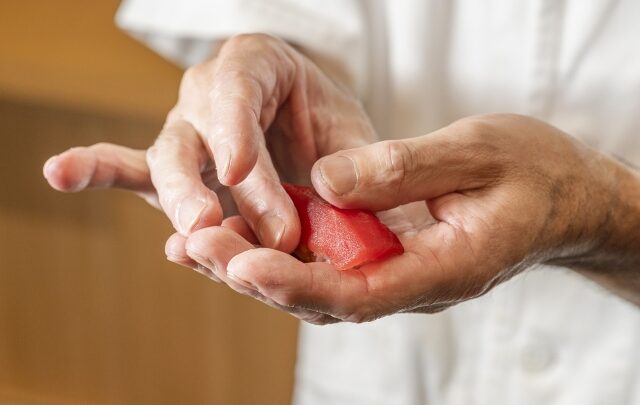
Good nigiri should hold together when it is picked up, then loosen in the mouth rather than remain a hard block of compressed rice. A chef can make small adjustments according to the fish and the condition of the rice at that moment.
This does not mean that “made by hand” automatically guarantees a great meal. It means that hand-shaped sushi gives a skilled chef more opportunities to improve each piece.
If taste alone is your priority, sushi prepared and adjusted by a capable chef will generally offer a higher ceiling than highly standardized, machine-assisted sushi. If price, speed, variety and ease of ordering also matter, casual sushi may be the better experience for that meal.
Rice is only one part of sushi. Fish, season, location, distribution and preparation also matter.
In a region known for seafood, a local conveyor-belt restaurant may offer fish from nearby waters, species rarely seen on overseas menus and seasonal items valued by local customers. The restaurant can remain casual while giving visitors access to seafood that makes the meal distinctive.
In a major city, the opposite can also be true. Tokyo is not close to every fishing ground, yet fish arrives from across Japan. Wholesalers select it, logistics keep it in suitable condition, and chefs decide whether it should be served immediately, rested, cured, marinated, simmered or otherwise prepared.
Japan’s fish culture developed through the work of specialized people—including fishers, market professionals, wholesalers and chefs—rather than through freshness alone.[^2] You can explore that wider background in our guide to Japanese fish culture.
This is why “closest to the port,” “most expensive” and “served by hand” are each useful clues, but none is a complete answer by itself.
The following framework is based on how a Japanese sushi professional described the different kinds of value that diners receive from sushi. These are not official restaurant categories, and they do not cover every restaurant. They are a practical map for travelers deciding what kind of meal to seek.
| Experience | Where to Go | Main Value | Best For—and What You May Notice Next |
|---|---|---|---|
| Everyday Japanese sushi | A major casual conveyor-belt or express-lane chain | Consistency, speed, choice and price | A good first experience: learn the taste of Japanese sushi rice and the pleasure of trying many small plates |
| Casual sushi in a seafood region | A regional conveyor-belt restaurant, sometimes with chefs preparing orders by hand | Local or regional fish combined with casual prices | For travelers who enjoyed casual sushi: discover seasonal fish and species rarely seen overseas |
| Chef-run sushi in a seafood region | An independent restaurant in a port town or regional city | Local fish, seasonality and the chef’s preparation | For diners ready to compare: notice how the rice loosens, and how curing, marinating and real wasabi change a piece |
| High-end sushi in a major city | A reservation-focused counter or omakase restaurant | National distribution, wholesale selection, ageing, curing, technique and course design | For experienced sushi diners: notice how timing and course order change the pieces that follow |
The table is not a ranking from bad to good. It shows four different places where value can be created.
The burger comparison used earlier explains the difference between standardization and individual adjustment. It does not mean that conveyor-belt sushi is culturally disposable, or merely an inferior version of chef-run sushi.
Imagine telling Japanese diners that the country could preserve only one of two experiences for future generations: casual conveyor-belt sushi or sushi prepared by a chef at the counter. The answer would not be obvious. Chef-run sushi protects a high level of craft, but conveyor-belt sushi makes sushi accessible as an everyday pleasure—somewhere families can visit, individuals can eat casually and anyone can choose several favorites one plate at a time.
Japan’s sushi culture is strong because it has both a broad base and a high ceiling. Losing either experience would make it poorer.
This is the easiest starting point for many visitors.
You can learn how Japanese vinegared rice tastes, try several toppings without ordering a full portion, and discover how broad the menu of an everyday sushi restaurant can be. Even if you never move beyond this level, you can still have a satisfying meal.
Choose this experience when:
Do not treat the restaurant as a test you must pass before eating “real sushi.” Treat it as Japan’s highly developed casual form of sushi.
If your itinerary includes Hokkaido, Hokuriku or another region known for seafood, look beyond national chains.
Regional conveyor-belt restaurants may feature fish landed nearby, local species and seasonal recommendations. Some employ chefs who cut fish and prepare each order in the restaurant. The experience remains relaxed and comparatively affordable, but the ingredients and preparation may be more closely tied to the region.
Sapporo’s official tourism information, for example, highlights local conveyor-belt restaurants that emphasize seafood from Hokkaido and nearby production areas.[^3]
Useful searches include:
regional conveyor belt sushi Sapporolocal kaiten sushi Kanazawalocal sushi chain Hokkaidosushi near Toyama StationLook for menus and reviews that mention local fish, seasonal recommendations and where the seafood comes from. A large menu of tuna and salmon alone does not tell you what makes the region distinctive.
The next step is an independent restaurant in a port town or regional city where local fish is shaped by a chef’s judgment.
The value is no longer only that the fish was landed nearby. The chef decides how to cut it, whether to serve it immediately, how much rice it needs and whether curing, marinating, ageing or another preparation will improve it.
Choose this experience when:
Before visiting, check whether the restaurant offers individual orders, a set menu or omakase; whether reservations are required; and whether it can accommodate allergies or foods you cannot eat.
High-end sushi in Tokyo or another major city represents a different kind of peak.
Its strength does not come from being beside a fishing port. It comes from access to fish from many regions, relationships with wholesalers, careful storage and preparation, control of rice and temperature, and the chef’s ability to construct an entire sequence.
This is the right choice when:
Higher prices do not come only from expensive fish. At its best, the experience integrates sourcing, preparation, rice, seasoning, timing and progression.
The difference is not simply quieter décor and a higher bill.
| Element | Highly Standardized Casual Sushi | Chef-Run Sushi |
|---|---|---|
| Rice | Uniform portions designed for speed and consistency | Amount, pressure, shape and temperature can be adjusted piece by piece |
| Fish | Standardized cuts and preparation | Cut and preparation can change according to species and condition |
| Seasoning | Often adjusted by the customer | Soy sauce, salt, citrus and wasabi may be applied by the chef |
| Timing | Designed for efficient service | Each piece may be served when the chef considers it ready |
| Choice | Customer selects freely from a broad menu | The chef may guide the order or compose an omakase sequence |
| Main advantage | Price, convenience, variety and reliability | Integration of fish, rice, seasoning, temperature and timing |
The green paste served as wasabi is not always made primarily from the Japanese wasabi plant. Even in Japan, inexpensive wasabi—including the type commonly found at conveyor-belt restaurants—may be made from less expensive horseradish.[^4]
Freshly grated hon-wasabi, or real Japanese wasabi, offers more than a stronger burn. It has a fresh aroma and a sweetness that prepared substitutes do not reproduce in the same way. Its sharpness travels through the nose and then fades.
At a chef-run sushi restaurant, wasabi can become part of the design of each piece. The chef may adjust it to the fattiness, texture and flavor of the fish instead of leaving the customer to add the same amount afterward.
Not every independent restaurant serves freshly grated real wasabi, but when you encounter it, it can be one of the clearest signs that you have moved into a different sushi experience. Read more about real Japanese wasabi and the horseradish-based substitute commonly served abroad.
You do not need to jump from inexpensive conveyor-belt sushi directly to one of Japan’s most exclusive counters.
If your first sushi meal in Japan is already one of the most expensive counters in Tokyo, it may be excellent. But without a reference point, it can be difficult to understand which details made it exceptional—and difficult to imagine where to go next.
If you begin with casual sushi and enjoy it, each step can reveal something new:
The comparison does not make an expensive meal meaningful simply because it costs more. It helps you understand what changed—and what the additional price actually bought.
Rather than searching for one restaurant that represents all Japanese sushi, try two contrasting meals.
Good combinations include:
The point is not to prove that the second restaurant is better. It is to notice where the difference comes from.
Casual sushi shows how wide and accessible Japan’s sushi culture has become. Regional restaurants show the importance of place and local seafood. Chef-run shops show how rice, fish, wasabi, seasoning and timing can be integrated. Major-city counters show what distribution, wholesale expertise and intense professional competition can produce.
This is one reason food becomes such an important part of travel in Japan: a familiar dish can change as you move between price levels, regions and specialists. We explore that wider pattern in why foreign visitors travel through Japan by eating.
The best first sushi in Japan does not have to be the best sushi money can buy.
Begin with the experience that suits your knowledge, location, budget and companions. Japan’s casual conveyor-belt sushi is already a worthwhile part of its food culture. If it makes you want more, move to a regional restaurant or a chef-run shop and pay attention to what changes.
The most rewarding sushi journey is not necessarily one leap to the highest price. It can be a series of discoveries—from standardized rice to a chef’s touch, from familiar fish to regional species, and from casual wasabi paste to freshly grated hon-wasabi.
Japan does not have only one “best” sushi experience. It has several different kinds of excellence, and the pleasure lies in learning to taste the difference.
[^1]: The Government of Japan, “Robots Carry Sushi Artisanship to the Future”
[^2]: Fisheries Agency of Japan, “Nigiri-zushi Born in Edo and Spread Around the World” (Japanese)
[^3]: Sapporo Travel, “Locals’ Guide to the Best Conveyor-Belt Sushi in Sapporo”
[^4]: Ministry of Agriculture, Forestry and Fisheries, “Harvesting Fresh Wasabi in the Beautiful Fields of Shizuoka”