What Is Monjayaki? Tokyo’s Local Griddle Food That Blends Cooking and Play
CoCoRo編集部
CoCoRo

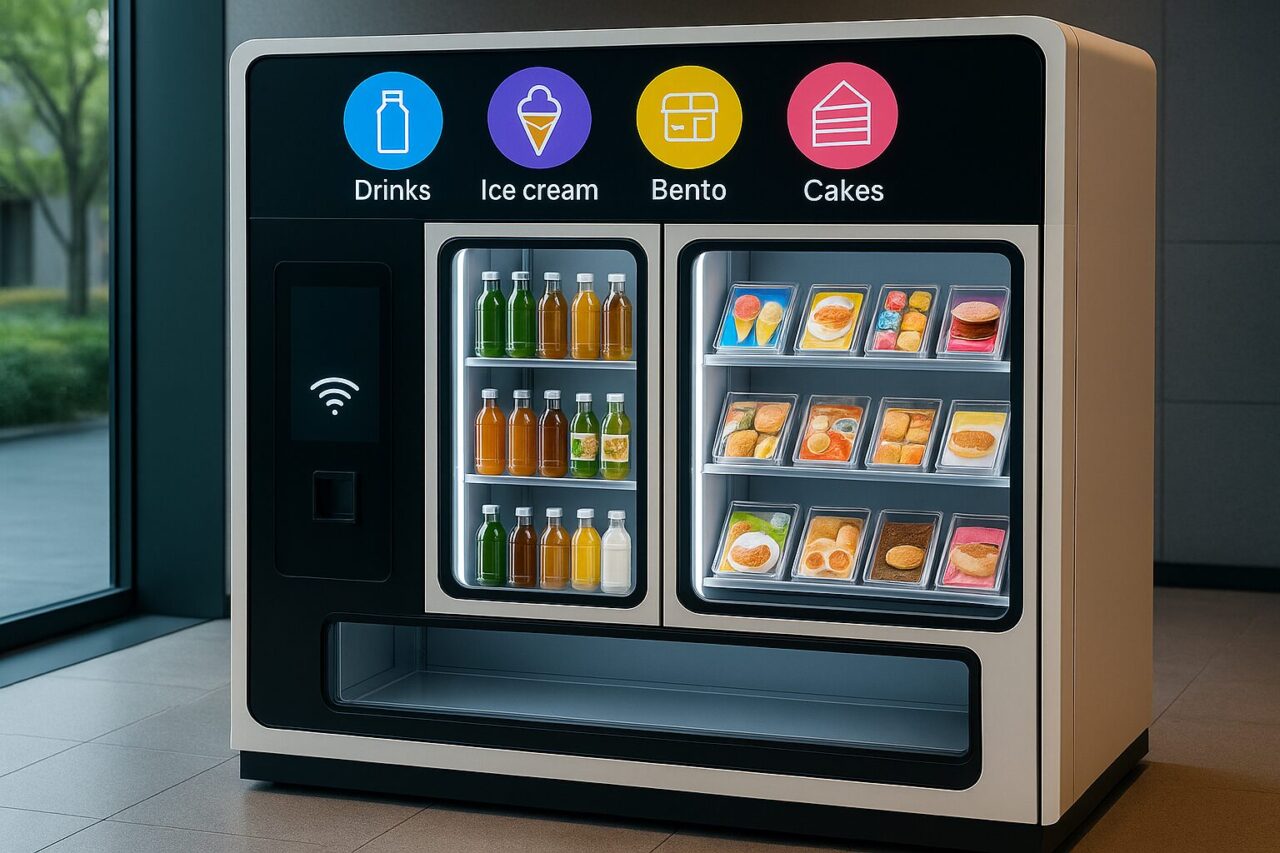
For many visitors, vending machines are part of the image of Japan. They glow beside train stations, stand outside small shops and appear on streets where there seems to be no other place to buy a drink. Some sell hot coffee in winter and cold tea in summer from the same machine.
Japan still looks like a vending-machine paradise. Yet behind that familiar streetscape, operators are removing machines, reassessing what they are worth and abandoning the old belief that more machines automatically mean more profit.
So, are Japan’s vending machines really disappearing?
Yes, their number is declining. But they are not vanishing overnight. Japan still has millions of machines, and tourists will continue to see them. The more important change is happening behind the machines: a location that once produced easy, steady sales may no longer earn enough to cover higher product, electricity, delivery and labor costs.
Japan is moving from an era when finding somewhere to place another machine created value to an era when operators must decide which machines are worth keeping.
According to the Japan Vending System Manufacturers Association, Japan had 3,881,700 vending and automated service machines at the end of 2025.
That number needs a little context. It includes not only machines that sell drinks, food, cigarettes and tickets, but also automated payment machines, lockers, money changers and rental machines.
The number of machines that actually sell products was 2,585,200. Automated service machines accounted for the remaining 1,296,500.
| What is being counted? | Number in 2025 | What it includes |
|---|---|---|
| Product vending machines | 2,585,200 | Drinks, food, cigarettes, tickets and daily goods |
| Automated service machines | 1,296,500 | Payment machines, lockers, money changers and rental machines |
| Combined total | 3,881,700 | Both categories |
The distinction matters, but the long-term direction is the same: the total has been falling gradually.
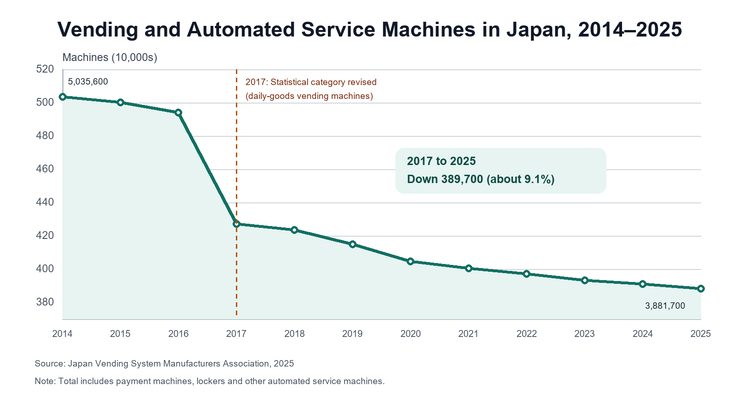
| Year | Machines | Year-on-year index |
|---|---|---|
| 2014 | 5,035,600 | 98.9% |
| 2015 | 5,001,700 | 99.3% |
| 2016 | 4,941,400 | 98.8% |
| 2017 | 4,271,400 | 86.4% |
| 2018 | 4,235,100 | 99.2% |
| 2019 | 4,149,100 | 98.0% |
| 2020 | 4,045,800 | 97.5% |
| 2021 | 4,003,600 | 99.0% |
| 2022 | 3,969,500 | 99.1% |
| 2023 | 3,931,900 | 99.1% |
| 2024 | 3,910,300 | 99.5% |
| 2025 | 3,881,700 | 99.3% |
The sharp step in 2017 does not mean that hundreds of thousands of machines were suddenly removed from Japanese streets. The industry changed which daily-goods machines it included in the statistics that year.
The period from 2017 onward is more useful for understanding the recent trend. Between 2017 and 2025, the combined total fell by 389,700 machines, or about 9.1%. Since 2018, it has declined a little every year.
This is not a sudden disappearance. It is a slow retreat that has continued long enough to change the streetscape.
The machines most travelers recognize are those selling bottled and canned soft drinks. In 2025, Japan had 1,975,200 of them.
The broader beverage-machine category totaled 2,178,800 because it also includes paper-carton milk machines, cup-based coffee and cocoa machines, and machines selling alcoholic drinks.
Both numbers can appear in news reports about Japanese drink machines. They are not contradictory; they count different categories.
Falling below two million bottled and canned soft-drink machines is still symbolically important. These are the bright machines found along roads, outside offices and near stations—the machines most closely associated with Japan’s everyday vending culture.
The decline is not evenly distributed.
| Type | Machines in 2025 | Year-on-year | What it shows |
|---|---|---|---|
| Beverage vending machines | 2,178,800 | 99.1% | A gradual decline |
| Food vending machines | 81,100 | 99.9% | Almost unchanged |
| Cigarette vending machines | 57,100 | 86.6% | A rapid decline |
| Ticket vending machines | 63,700 | 100.3% | A slight increase overall |
| Daily-goods vending machines | 204,500 | 100.1% | Almost unchanged |
Cigarette vending machines fell by 13.4% in a single year, while food machines were almost unchanged and ticket machines increased slightly.
In other words, Japan is not losing every kind of machine at the same speed. Some have lost their old role, while others still solve a practical problem.
From the customer’s side, a vending machine looks simple. Insert money, press a button and receive a drink. From the operator’s side, every machine is a small retail location that must sell enough products to justify keeping it there.
| Reason | What customers notice | What operators face |
|---|---|---|
| Higher drink prices | Vending-machine drinks feel expensive | Fewer purchases at weaker locations |
| Cheaper stores nearby | The same drink costs less elsewhere | Stronger price competition |
| Rising operating costs | Usually invisible to customers | Higher electricity, labor and delivery costs |
| Changing foot traffic | Some streets and offices are quieter | More unprofitable locations |
| Fewer cigarette sales | Cigarette machines disappear from neighborhoods | One category is shrinking rapidly |
| Digital alternatives | Fewer people need physical tickets | Some ticket machines lose their role |
The price of a drink from a vending machine includes convenience. Customers are paying to buy a cold or hot drink immediately without entering a store or waiting at a checkout.
That premium becomes harder to accept when household budgets are tight. Supermarkets and drugstores often sell the same bottled drink for much less, while convenience stores combine drinks with food, toilets, ATMs and other services.
When prices rise, customers do not necessarily stop buying drinks. They may buy them elsewhere, carry a reusable bottle or purchase several bottles at once from a cheaper shop.
This is one reason Japan’s highly developed retail network has become a challenge for the machines it once existed alongside. For a closer look at that retail culture, see Japanese Convenience Stores: A Cultural Re-evaluation.
A vending machine has no cashier, but it is not labor-free.
Someone must decide what to stock, load the products onto a truck, drive to the location, refill the shelves, collect or manage payments, remove empty containers, clean the machine and respond when something breaks.
This system works well when a machine sells many drinks. A delivery route can serve several profitable locations efficiently.
The economics change when a driver must travel farther to refill a machine that sells only a few drinks a day. The machine still uses electricity and still occupies a location. It still needs inspection, cleaning and repair. A machine that looks passive from the street can be expensive to keep alive.
As energy, labor and transportation costs rise, operators care less about how many machines they own and more about how much each stop on a delivery route earns.
Japan’s population is changing, but so is the way people move through cities.
Remote and hybrid work altered demand around some office districts. Rural depopulation reduced traffic along some roads. Shopping habits shifted toward larger stores, online ordering and planned purchases. A machine that once stood on a busy route can become unprofitable even if the surrounding neighborhood still exists.
Operators are therefore not removing machines at random. They are concentrating them in places with reliable demand: stations, factories, hospitals, schools, hotels, tourist sites and busy workplaces.
This helps explain why a traveler can still feel surrounded by vending machines while the national total continues to fall. Visitors spend much of their time in exactly the places where machines remain valuable.
Cigarette vending machines were once a familiar part of Japanese neighborhoods. Their decline is much more visible than the slow reduction in drink machines.
Smoking habits have changed, cigarette sales have moved toward staffed convenience stores, and age-verification requirements made a simple street machine less convenient. The taspo identification-card service also ended in 2026.
The result can be seen in the 2025 data: only 57,100 cigarette machines remained, 13.4% fewer than one year earlier.
When a category that was once common disappears this quickly, people naturally feel that Japanese vending machines as a whole are vanishing faster than the total figures suggest.
National machine numbers tell us what is visible on the street. Corporate results tell us whether operating those machines still makes financial sense. The two do not always change at the same speed.
In its financial results for the year ended December 2025, Coca-Cola Bottlers Japan Holdings reported an impairment loss of ¥90.497 billion, mainly related to its vending business.
This does not mean that ¥90.497 billion in cash disappeared or that the company removed that value of machines in one year. It means that the company reassessed its vending assets and concluded that they were likely to generate less profit in the future than previously expected.
The company’s ordinary business-profit measure actually improved during the year. The message is therefore more interesting than “Coca-Cola could no longer sell drinks.” Its overall operations improved, while the expected value of the traditional vending network was revised sharply downward.
One of Japan’s largest beverage operators was effectively acknowledging that the old assumptions behind vending-machine profitability no longer held.
Imagine two machines that each remain in place for another year. One continues to sell dozens of drinks a day. The other sells fewer drinks after price increases, while electricity, delivery and labor costs rise.
The official machine count has not changed: two machines are still operating. Their combined profitability, however, may have fallen considerably.
This is why a decline of around 1% in machine numbers can coexist with large corporate losses, impairment charges and restructuring. Operators may first change product selection, reduce refill visits and reorganize delivery routes. Removal comes when those measures are not enough.
The industry is not disappearing, but the business model based on expanding the number of machines is coming to an end.
For decades, a large vending network gave beverage companies direct access to customers. They controlled the display, avoided competing brands on the same shelf and could sell at retail prices around the clock.
That network still has value. What has changed is the belief that another machine is automatically an asset. A poorly located machine can now be a burden.
To understand why the current decline feels so significant, it helps to remember how Japan became a vending-machine nation.
About 25 years ago, there were even part-time jobs that involved searching for promising vending-machine locations and asking landowners for permission to install one.
The existence of such work says something about the period. Expanding the network itself was considered a path to growth. If a company secured a good location, the machine could continue producing sales without the expense of operating a complete shop.
Today, the direction has reversed. Operators are less focused on finding as many new locations as possible and more focused on deciding which existing locations are still worth serving.
The old job was about finding somewhere to add a machine. The modern business is increasingly about identifying which machines to keep.
Today, Japan’s convenience stores make it easy to buy drinks late at night. But before convenience stores became ubiquitous, a vending machine was one of the few ways to buy something at any hour without keeping a shop open.
This mattered during Japan’s period of rapid urban and economic growth. More commuters, factories, offices and busy roads created more places where people wanted a quick drink.
The machine did not need a large building or a permanent cashier. It turned a small piece of unused space into a tiny 24-hour shop.
Putting a machine outdoors requires more than low crime.
The machine must survive weather and daily use. Products must stay at safe temperatures. Electricity must be reliable. Delivery routes must reach the location regularly, and someone must keep the machine clean and working.
Japan combined these practical systems with a public environment where outdoor machines could become ordinary rather than exceptional. The same everyday maintenance that shapes visitors’ impressions of Japan’s streets also helped vending machines become part of the landscape. That wider context is explored in Why Is Japan So Clean?.
Japanese drink machines also adapted well to the seasons. A single machine can offer chilled tea and water alongside hot coffee, tea or soup-like drinks.
The products change as the weather changes. A commuter can buy hot coffee on a winter morning and cold sports drinks during a humid summer. That seasonal usefulness made vending machines feel less like novelty technology and more like a dependable part of daily life.
The future will not be divided simply between old machines and futuristic machines. The more useful distinction is whether a machine has a clear reason to be in its location.
| More likely to disappear | More likely to survive |
|---|---|
| A drink machine with few daily customers | A machine at a station, hospital or busy workplace |
| A machine that is simply more expensive than a nearby store | A machine that saves customers meaningful time |
| Cigarette vending machines | Food and ticket machines that reduce staffing needs |
| Machines on inefficient delivery routes | Machines connected to efficient restocking systems |
| Machines with no special reason to be there | Machines serving tourists, communities or emergencies |
Operators can use sales history, time of day, weather and local demand to decide what each machine should stock and when it needs to be refilled.
The purpose of this technology is not to cover Japan with even more machines. It is to avoid empty shelves, reduce unsold products and cut unnecessary delivery visits.
A smarter machine is valuable only if it improves a real business decision. AI cannot turn a quiet location into a busy one, but it can help an operator recognize the difference sooner.
Frozen gyoza, ramen, meat, cakes and restaurant meals became highly visible during the pandemic. Unattended selling allowed restaurants and producers to reach customers outside normal opening hours.
That did not create endless growth. The industry association’s 2025 report says that the wave of new demand for frozen-food machines has run its course. Food vending machines were almost unchanged from the previous year.
The machines that remain need more than an unusual product. They need a reason for customers to buy that product from a machine—such as late-night availability, a location without nearby shops or an item unavailable elsewhere.
For travelers, the machine itself can still be part of the experience. Hot and cold products displayed together, regional drinks, unusual foods and cashless payment options can make an ordinary purchase memorable.
Machines can also serve a wider local purpose. Some can release products during emergencies or display public information. Others function as small unmanned shops in places where staffing a store would be unrealistic.
These extra roles will not rescue every machine. They do, however, give a station, hotel, tourist site or community a reason to keep a particular machine even as the national total falls.
Yes. Visitors will continue to find vending machines at stations, hotels, tourist sites, hospitals and busy streets.
The machines most likely to disappear are those that sell too little to justify the cost of restocking and maintaining them: an isolated machine on a quiet road, several similar machines competing beside one another or an older machine near a cheaper store.
This creates an apparent contradiction. Japan can lose hundreds of thousands of vending machines nationally while they remain highly visible along a typical travel route through Tokyo, Osaka, Kyoto or another major destination.
Travelers may notice fewer machines in quiet residential and rural areas, but vending machines will remain part of the Japanese travel experience for the foreseeable future.
Japan’s vending machines are genuinely declining. The 2025 figures are not simply a story created by dramatic headlines.
But the machines are not disappearing in a single wave. The national total has fallen gradually, while the economic assumptions behind the business have changed much more quickly.
In the past, finding a new place for a vending machine created value. Today, the industry creates value by deciding which machines are worth keeping.
Japan will have fewer vending machines, but the machines that remain will have a clearer reason to be there.
Japan had 2,585,200 machines that sold products at the end of 2025. When automated service machines such as payment machines, lockers and money changers are included, the combined total was 3,881,700.
Drinks have become more expensive, supermarkets and drugstores offer cheaper alternatives, and electricity, labor and delivery costs have increased. Operators are removing machines that do not sell enough to justify those costs.
The combined number of vending and automated service machines fell from 4,271,400 in 2017 to 3,881,700 in 2025, a decline of about 9.1%. Since 2018, the total has fallen a little every year rather than collapsing all at once.
The industry changed the machines included in its daily-goods category. The large statistical drop in 2017 therefore does not represent only machines physically removed from the streets.
Customers can often buy the same drink for less at supermarkets or drugstores. At the same time, operators must pay more for products, electricity, workers, delivery and maintenance. Low-selling locations become difficult to justify.
Smoking and purchasing habits have changed, more cigarettes are sold in staffed stores, and age-verification requirements reduced the convenience of street machines. The taspo card service also ended in 2026.
They are becoming harder to justify for price-sensitive customers. Many people still pay for immediate convenience, but others choose cheaper shops or carry drinks purchased elsewhere.
Japan clearly has an unusually visible vending-machine culture, but there is no single official global ranking that counts every country using the same definition. Claims about one machine per a certain number of people often mix product machines with lockers, payment machines and other automated services.
No, but its old growth model is weakening. Operators are reducing unprofitable locations and concentrating on machines that save time, reduce staffing needs or serve reliable demand.
Yes. They will remain common at stations, hotels, tourist sites, hospitals and busy streets. The decline is more likely to affect low-volume machines in quiet or inefficient locations.