What Is Shokibarai? Japan’s Summer Custom for Beating Heat with Food, Drinks, and Gatherings
CoCoRo編集部
CoCoRo

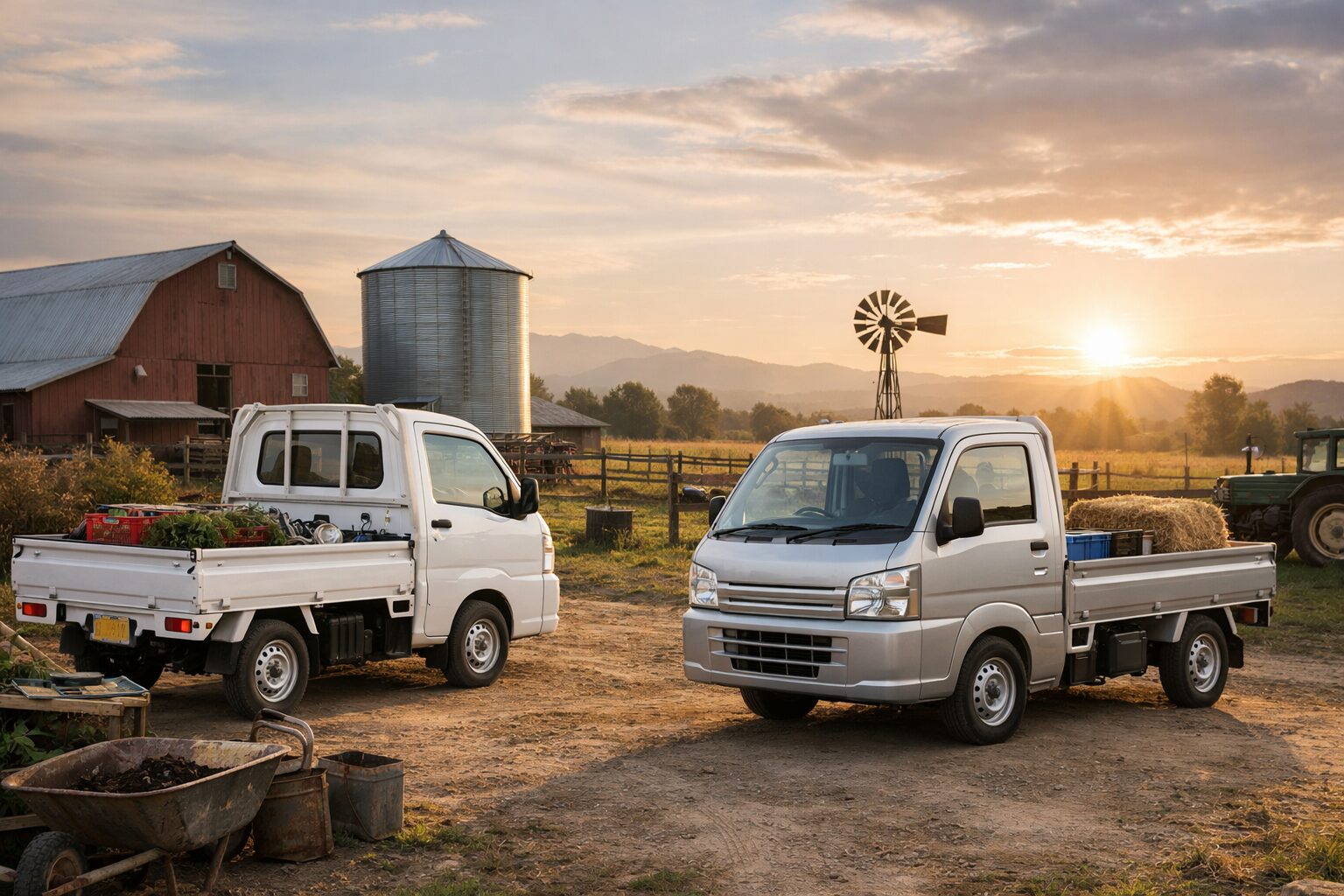
You may never have seen a kei truck on the road. Yet if you watch anime or play games set in present-day Japan, you may have already seen one without knowing its name. A tiny truck parked beside a field, carrying tools at a construction site, or making deliveries behind a neighborhood shop is often simply part of the background.
In Japan, that background vehicle is indispensable. Kei trucks carry farming tools, fertilizer, produce crates, building materials, drink cases, branches, and muddy equipment—loads that are awkward, bulky, or dirty for a passenger car but do not require a large truck.
Japanese people knew how useful kei trucks were. What few expected was that a vehicle seemingly shaped by Japan’s narrow roads and limited working spaces would also fit life on vast American farms and ranches.
Kei trucks are gaining attention overseas because they are small enough for narrow tracks, useful enough to carry real loads, and economical for repeated jobs that do not require a full-size pickup. The landscape may be completely different, but the work can be surprisingly similar.
A kei truck is a small cargo truck built to fit Japan’s legal kei vehicle class. The word kei comes from keijidōsha, meaning “light automobile.” In English, these vehicles are usually called kei trucks, although Japanese mini truck and mini truck are also used.
“Kei” does not refer to a manufacturer or model. It refers to a Japanese vehicle category with limits on body size and engine displacement.
Under Japan’s current kei rules, a three- or four-wheeled vehicle may be no more than 3.40 metres long, 1.48 metres wide, and 2.00 metres high, with an engine displacement of no more than 660 cc. Representative current kei trucks have a maximum payload of 350 kg.
| Item | Metric | Approximate U.S. unit |
|---|---|---|
| Maximum length | 3.40 m | 11.2 ft |
| Maximum width | 1.48 m | 4.9 ft |
| Maximum height | 2.00 m | 6.6 ft |
| Maximum engine displacement | 660 cc | 0.66 litres |
| Representative current payload | 350 kg | 772 lb |
The dimensions and engine limit come from the Light Motor Vehicle Inspection Organization’s explanation of Japan’s kei standards. The payload figure describes representative current Japanese kei trucks; it should not be applied to every vehicle marketed overseas as a “mini truck.”
Its size can make a kei truck look like recreational equipment, but in Japan it is an ordinary registered motor vehicle. It has a cab, licence plate, lights, mirrors, seat belts, and an open cargo bed. Depending on the model and specification, rear-wheel drive and four-wheel drive are available.
That does not mean every kei truck can be registered for ordinary road use in another country. Overseas rules depend on the vehicle’s age, national import requirements, and local registration laws.
Kei trucks are easy to overlook precisely because they are so ordinary in Japan.
When an anime, manga, film, or game depicts contemporary Japanese life, a kei truck may appear beside a rice field, behind a shop, near a building site, or on a narrow neighborhood road. It is often not important to the plot. It is there for the same reason utility poles, vending machines, bicycles, and convenience stores are there: it helps make the setting recognizably Japanese.
An overseas viewer may therefore recognize the shape before learning the term kei truck. The small cab, flat open bed, and narrow body are familiar visual details, even to someone who has never encountered the vehicle in person.
The vehicle does not have to be important to the story. Its unremarkable presence is the point: the kei truck belongs to the visual vocabulary of modern everyday Japan, not only to car culture.
The easiest way to understand a kei truck is not to begin with horsepower. It is to look at what people put in the bed and how often they load and unload it.
A farmer may load long-handled tools, bags of fertilizer, harvest crates, irrigation parts, or muddy machinery into the bed. These items are inconvenient to place inside a passenger car. They may be long, irregularly shaped, wet, dusty, or covered in soil.
The open bed allows them to be loaded without protecting carpet or folding seats. A compact body can enter farm lanes and work close to fields, sheds, and greenhouses. Four-wheel-drive versions are useful where surfaces are uneven or unpaved.
Kei trucks also carry ladders, timber, pipes, tools, plants, branches, and equipment for construction, repair, gardening, and landscaping work.
These are not always heavy loads, but they are often difficult to fit inside a car. The truck can stop close to the job, unload quickly, and move to the next location without occupying the space of a larger commercial vehicle.
Rice shops, liquor shops, greengrocers, fish sellers, and other local businesses have long used small trucks for regional deliveries. Bags, boxes, crates, and cases must be delivered through narrow streets and unloaded near shop entrances.
The same pattern appears in deliveries to restaurants and izakaya pubs: cargo that is awkward for a passenger car, several stops within a limited area, and repeated loading and unloading.
In rural and suburban life, a kei truck may also carry firewood, gardening waste, furniture, event equipment, or materials for neighborhood work. It is the vehicle people turn to when an object will not fit comfortably inside a car but hiring or operating a larger truck would be excessive.
This range of uses matters. Japanese people did not fail to recognise the kei truck’s value. They knew it was essential to logistics and daily life. What seemed unlikely was that this value—so closely associated with Japan’s roads, regulations, farms, shops, and neighborhoods—would translate overseas.
Expressions such as inaka no Porsche—literally, a “countryside Porsche” or “rural Porsche”—are sometimes used jokingly for kei trucks in Japan. The joke should not be romanticised.
A kei truck can be treated as the opposite of a glamorous car. It is associated with farms, work clothes, tools, mud, and country life. Calling it a Porsche creates an obvious mismatch, which is what makes the phrase funny.
The teasing is usually not a serious claim that the vehicle is useless or inferior. Even people who laugh at its rural image often understand that it is remarkably practical.
For many owners, a kei truck is not a sentimental lifestyle accessory. It is the vehicle that makes the work possible. Without it, carrying tools, produce, equipment, branches, or cases would become slower and harder.
That is the practical truth behind the joke. It may not look prestigious, but when the job needs doing, it is often the most dependable vehicle available.
Car enthusiasts often connect both “rural Porsche” and nōdō no Porsche—“Porsche of the farm road”—more specifically with older Subaru Sambar models.
Subaru-built Sambars through the sixth generation placed the engine at the rear and drove the rear wheels, an RR layout also associated with the Porsche 911. That mechanical coincidence helped the nickname spread among enthusiasts. Japanese automotive publication webCG describes the older Sambar as having been called both the “rural Porsche” and the “Porsche of the farm road” for this reason.
The comparison does not imply Porsche-like speed or identical engineering. It is a light joke that works because people recognise both the unusual layout and the truck’s real capability. The phrase also became the title of Setsuko Shinoda’s 2021 road novel Inaka no Porsche, whose central journey takes place in a kei truck.
Japan’s narrow roads and America’s vast private properties appear to be opposite environments. Yet the vehicle can encounter a similar pattern of work in both places.
A large farm or ranch does not consist only of long highway journeys. Everyday work includes repeated trips between a house, barn, field, fence, shed, animals, and equipment.
Tools, feed, fencing materials, plants, produce, and small machines have to move with the worker. The land is large, but each individual job may take place at low speed over a relatively short distance within the property.
Many of these loads are too bulky, awkwardly shaped, or dirty for a passenger car. Carrying them by hand is inefficient. Yet they may not require the towing capacity, highway ability, size, or payload of a full-size pickup.
This is the gap in which a kei truck makes sense. It is not replacing every pickup. It is replacing the use of a much larger vehicle for a much smaller job.
The narrow body can move around barns, through gates, and along work tracks. The open bed can take crates, bags, tools, branches, and equipment without putting them inside the cab.
The representative 350 kg—or about 772 lb—payload is modest by truck standards, but it is substantial enough for many everyday property tasks. Available four-wheel drive also helps explain the appeal of imported models for agricultural use.
Fuel use is a practical advantage, but it should not be reduced to one universal miles-per-gallon claim. Most kei trucks entering the United States under the federal age exemption are at least 25 years old. Fuel economy varies by model, transmission, drivetrain, maintenance, load, terrain, and driving conditions.
The more reliable point is one of scale. If a job does not require a large truck, using a much smaller and lighter vehicle with a small engine can reduce the fuel used to perform it. That can matter when the same route is repeated throughout the day.
Kei trucks developed around work that involves driving, stopping, getting out, loading or unloading, and moving again. This rhythm appears in Japanese farming and local deliveries, but it also appears on American farms and ranches.
The countries are different in size. The work, once divided into individual tasks, can be remarkably similar.
A kei truck is not the right tool for every American driver. It is not designed to replace a full-size pickup for heavy towing, large payloads, long-distance comfort, or regular interstate driving.
Its usefulness comes from matching a specific job, not from outperforming larger trucks at the work they were built to do.
Overseas interest is still niche, but it is more than an online novelty.
According to figures reported by The Japan Agricultural News from Japan’s Ministry of Finance trade statistics, 7,050 used cargo vehicles in a category consisting mainly of kei trucks were exported to the United States in 2023.
The European Union received 747 vehicles in the same category. Together, the United States and EU received 7,797.
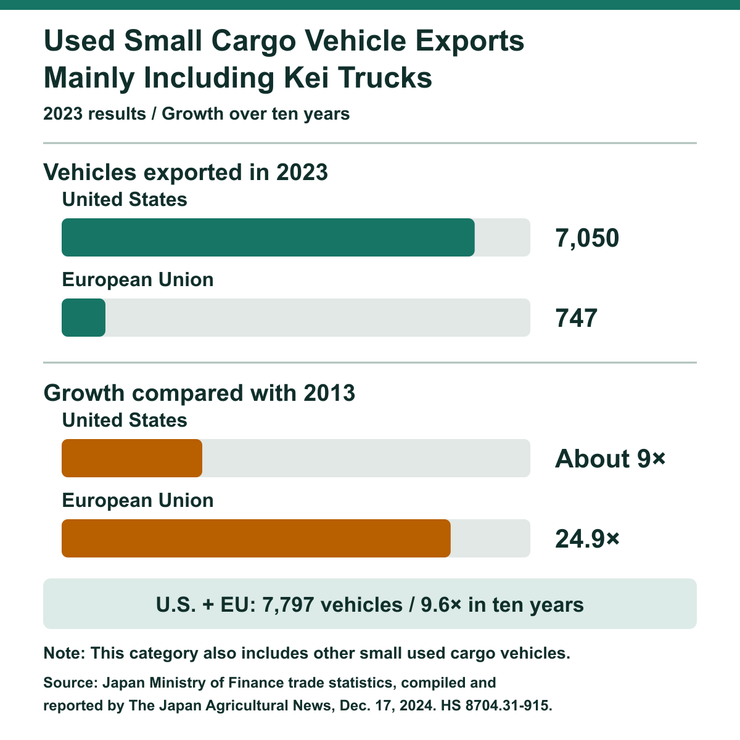
The U.S. figure was about nine times its level ten years earlier. EU exports were much smaller in absolute terms but reached 24.9 times their earlier level. The combined U.S.–EU total was 9.6 times higher.
These numbers do not mean that the average American now sees kei trucks regularly. The 7,050 figure is a single year’s export flow, not the total number present in the United States. Vehicles imported in earlier years also remain, while their distribution varies considerably by state and community.
The figures instead show two things at once: kei trucks remain unusual in the United States, and interest has increased sharply from a small base.
Data note: Japan does not publish a customs category limited exclusively to kei trucks. The cited category is used gasoline cargo vehicles with a gross vehicle weight of 5 tonnes or less and an engine displacement of 2,000 cc or less. It is described in the cited reporting as mainly consisting of kei trucks in this context, but it also includes other small used cargo vehicles. Source: The Japan Agricultural News, December 17, 2024; statistical code 8704.31-915.
Practicality explains why a kei truck can earn a place on a farm. It does not fully explain why people become enthusiastic about them.
The cab-over shape, tiny wheels, narrow body, right-hand-drive position, and older Japanese styling give the trucks an unmistakable character. They are functional, but they do not look anonymous.
For some owners, that makes a kei truck more enjoyable than ordinary utility equipment. It can carry tools on a weekday and still become a conversation piece at a gathering.
Kei trucks also overlap with interest in Japanese domestic-market vehicles. Owners modify them for farm work, mobile vending, camping, off-road use, display, and personal style.
That enthusiasm should not obscure their original purpose. The appeal begins with a real working vehicle. The novelty and custom culture grow around that usefulness.
Imported kei trucks are often old vehicles. Parts availability, corrosion, maintenance history, cabin space, noise, comfort, speed, and safety expectations all require realistic consideration.
Their legal treatment also varies. A vehicle may be eligible for federal importation without being eligible for registration or unrestricted road use in every state.
The useful comparison is not which country builds the better truck. It is which vehicle fits the job.
A kei truck can be a rational choice for low-speed work on private property, narrow tracks, frequent stops, repeated loading and unloading, and loads that are unsuitable for a passenger car but well below the capacity of a full-size truck.
A full-size pickup remains the appropriate tool for highway travel, substantial towing, heavier payloads, long-distance comfort, and work requiring greater power and capacity.
Calling a kei truck “enough” does not mean larger vehicles are unnecessary. It means that not every job needs their full capability.
There is no single nationwide answer covering registration and road use.
The U.S. National Highway Traffic Safety Administration states that a motor vehicle at least 25 years old may be lawfully imported without regard to whether it complies with applicable Federal Motor Vehicle Safety Standards. The 25-year period runs from the vehicle’s date of manufacture, not simply its model year.
This rule explains why many imported kei trucks are older Japanese models. See the NHTSA importation FAQ for the federal safety requirement.
Federal import eligibility is not the same as a state title, registration, or permission to drive on public roads. Some states allow kei trucks, some impose road or speed restrictions, and others may refuse ordinary registration.
The U.S. Environmental Protection Agency also applies separate emissions requirements and exemptions. Prospective importers should check EPA vehicle import guidance, NHTSA requirements, and the rules of the state where the vehicle will be registered.
The existence of the 25-year rule does not mean that a qualifying kei truck may be driven anywhere in the United States.
Kei trucks did not become valuable when overseas buyers discovered them. In Japan, they had long been essential to farming, construction, local delivery, household work, and everyday logistics.
What surprised many Japanese people was not that a kei truck could be useful. It was that a vehicle seemingly tied to Japan’s narrow roads, limited spaces, and kei regulations could perform a similar role on vast properties overseas.
The landscapes are opposite in scale. The individual jobs are not. In both places, workers need to carry loads that are awkward for a passenger car, travel short distances at low speed, stop repeatedly, and unload close to the work.
What changed overseas was not the kei truck’s value. What changed was our understanding of how far that value could travel.
“Kei truck” means a small cargo truck built for Japan’s legal kei vehicle category. Kei comes from keijidōsha, meaning “light automobile.”
Under current Japanese rules, a kei vehicle may be no more than 3.40 m long, 1.48 m wide, and 2.00 m high—approximately 11.2 ft long, 4.9 ft wide, and 6.6 ft high.
Representative current Japanese kei trucks have a maximum payload of 350 kg, or about 772 lb. Older vehicles and vehicles marketed more broadly as mini trucks may differ, so the specific model plate and documentation should be checked.
Their small engines and light weight can reduce fuel use for jobs that do not require a full-size pickup. There is no single reliable mpg figure for all imported kei trucks, especially because many are at least 25 years old and differ in condition, drivetrain, load, and use.
They fit work involving short, low-speed trips across private property, frequent stops, and loads that are awkward for a passenger car but do not require a full-size pickup. Their compact body, open bed, and available four-wheel drive are useful around fields, barns, gates, and work tracks.
It depends on the vehicle and the state. Vehicles at least 25 years old may qualify for the federal safety exemption, but state registration and road-use rules vary. EPA requirements must also be checked separately.
It literally means “countryside Porsche” or “rural Porsche.” The expression is used as a joke for a humble rural work vehicle that may not look prestigious but is extremely useful. In automotive contexts it is also strongly associated with older Subaru Sambar trucks.
Older Subaru-built Sambars used a rear-engine, rear-wheel-drive layout, which enthusiasts compared with the RR layout associated with the Porsche 911. The nickname is playful; it does not imply identical performance or engineering.