What Is Warabimochi? Japan’s Jiggly Summer Sweet Explained
CoCoRo編集部
CoCoRo

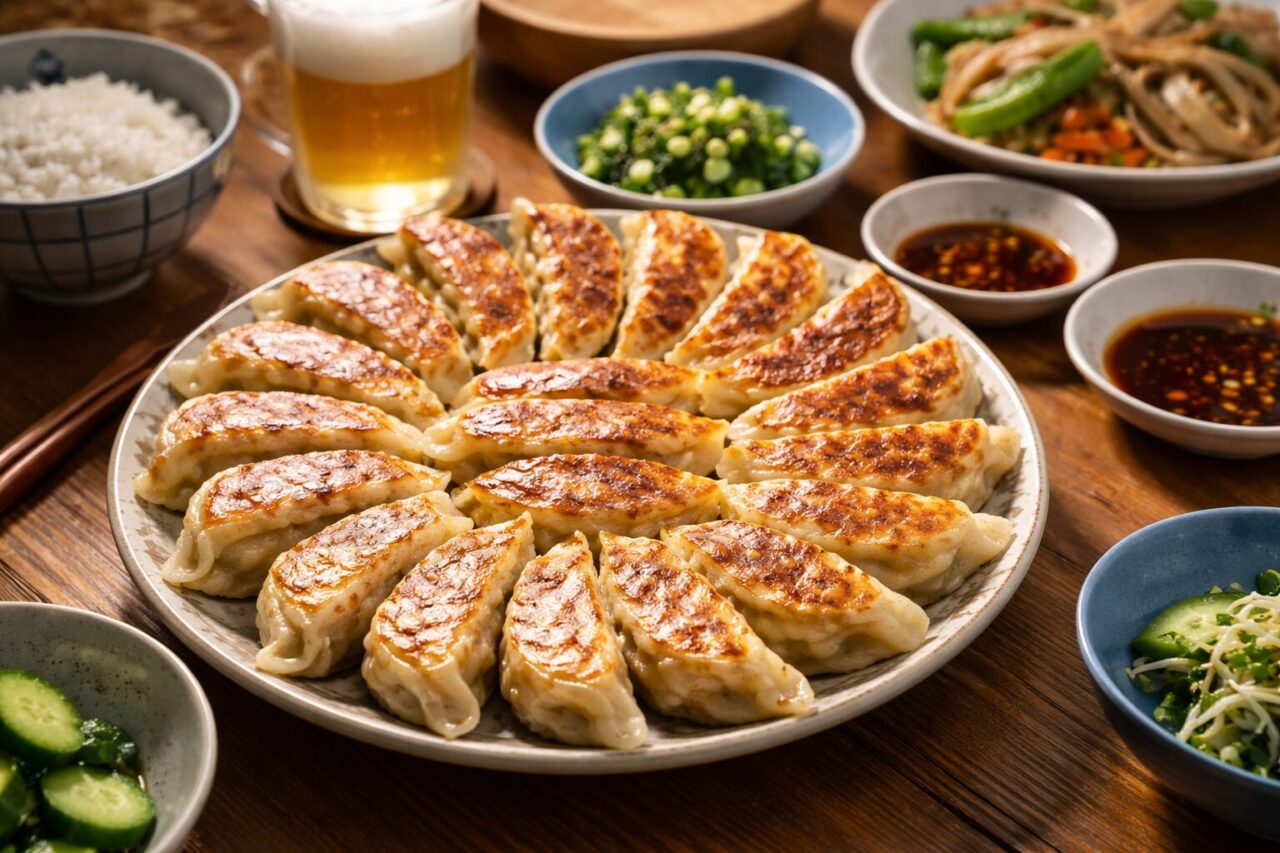
At the Tokyo 2020 Olympic Village, American rugby sevens player Ilona Maher discovered a food she could not stop talking about. She told her followers that the best gyoza in the world could be found inside the Olympic Village.
The surprise was not only that a Japanese dumpling had impressed an international athlete. It was that the gyoza was an everyday frozen product—the kind Japanese families keep at home for busy evenings.
How did frozen gyoza become good enough to attract global attention?
The answer begins in China, but it does not end with Japan copying a Chinese dish. Japan made the wrapper thinner, turned pan-frying into the standard method, placed gyoza beside rice and ramen, made families wrap it together, and spent decades improving the frozen version.
Japan did not invent the dumpling. It created a new everyday life around yaki-gyoza.
The Tokyo 2020 Olympic and Paralympic Games were held in 2021. Inside the Olympic Village dining hall, athletes encountered an enormous range of Japanese and international foods. One unexpected favorite was Japanese frozen gyoza.
Ilona Maher, a member of the U.S. women’s rugby sevens team, posted that the best gyoza in the world was in the Olympic Village. After returning home, she continued looking for Japanese gyoza and sharing the experience online.
For many Japanese people, this reaction was both flattering and funny. The food receiving international praise was not an expensive restaurant specialty. It was closely related to something sold in ordinary Japanese supermarkets.
That gap is the beginning of the story.
Japanese frozen gyoza was originally a way to avoid the time-consuming job of making filling, wrapping each dumpling and controlling the heat of the pan. But manufacturers did not stop at convenience.
They worked on the details that determine whether yaki-gyoza succeeds:
In 2012, Ajinomoto Frozen Foods introduced a version designed to cook without adding oil or water. The product could produce crisp, winged gyoza—known in Japan as hanetsuki gyoza—with fewer opportunities for the cook to make a mistake.
This is why the Olympic reaction matters. Japanese frozen gyoza was not admired because it perfectly imitated a handmade dumpling. Decades of development had turned it into a highly refined food in its own right.
The manufacturer’s 50-year history of Ajinomoto gyoza records both the oil-and-water-free improvement and Maher’s reaction at the Olympic Village.
Gyoza originated in China. The Japanese word gyoza comes from the Chinese dumpling tradition, and Japanese people encountered forms of jiaozi long before pan-fried gyoza became an everyday food.
But origin and present identity are not the same question.
Sushi has a long history inside Japan, while Japanese curry developed from a foreign influence. Ramen also has Chinese roots but is now unmistakably part of modern Japanese food culture. Gyoza belongs to the same broad story: a food can keep its foreign origin while acquiring a distinctly Japanese form and place in daily life.
In CoCoRo’s view, Japanese cuisine includes foods that people in Japan have loved, developed and passed on. By that definition, Japanese yaki-gyoza is both Chinese in origin and Japanese in the life it now lives.
This broader way of understanding washoku is explored in Why Is Japanese Food So Diverse? The Open Spirit of Washoku, which looks at how Japan has absorbed foreign influences without treating every adopted food as culturally temporary.
Someone who first falls in love with gyoza at a Japanese restaurant may imagine that a trip to China will reveal an even more “authentic” version of the same food.
Then a plate of boiled dumplings arrives.
The wrappers may be thicker and chewier. There may be no crisp underside. The dumplings may form the center of the meal instead of appearing beside rice or ramen. The traveler has not found an inferior version of Japanese gyoza. They have found the food tradition that Japanese gyoza changed away from.
China is vast, and both countries have many regional and modern variations. Still, comparing northern Chinese jiaozi with the Japanese gyoza most commonly served in casual restaurants reveals the central transformation.
| Point of comparison | Northern Chinese jiaozi | Common Japanese gyoza | What changed in Japan |
|---|---|---|---|
| Familiar cooking method | Boiled | Pan-fried and steamed in the same pan | The browned base became a major attraction |
| Wrapper | Relatively thick and chewy | Relatively thin | Attention shifted toward the filling and crisp surface |
| Role in the meal | Can serve as the staple food | Commonly treated as a side dish or main dish | A wheat-based dumpling became something eaten with rice |
| Common companions | Can make a meal by itself | Rice, ramen, fried rice or beer | Gyoza joined Japan’s set-meal and casual dining culture |
| Texture | Soft, elastic wrapper | Crisp underneath and soft on top | Contrasting textures became part of the ideal bite |
| Everyday setting | Homes, restaurants and seasonal occasions | Homes, ramen shops, machi-chuka, izakaya and specialist shops | Gyoza spread across both home cooking and casual dining |
The biggest difference is not simply boiling versus frying. It is the job the dumpling performs at the table.
In northern China, the wrapper can make jiaozi a staple food. In Japan, the thinner wrapper helped gyoza become a flavorful companion to rice.
Japanese gyoza became widely popular after World War II. Soldiers and civilians returning from northeastern China recreated dumplings they had eaten there. As the dish entered Japanese restaurants and homes, the pan-fried form spread.
Japanese yaki-gyoza is usually cooked in two stages without leaving the pan. The bottom is browned, then water is added so the upper part can steam. The result is crisp underneath, soft above and juicy inside.
That browned aroma matters. Japanese meals have long paired rice with grilled or seared foods: grilled fish, yakitori, teriyaki and even toasted rice balls. The smell and savoriness of browned gyoza, together with garlic, chives, pork and dipping sauce, made rice feel like a natural companion.
After the war, small Japanese-style Chinese diners helped make yaki-gyoza familiar. These establishments are now often called machi-chuka: neighborhood restaurants serving affordable dishes adapted to local appetites.
Gyoza worked especially well there because it could play several roles. It could complete a bowl of ramen, sit beside fried rice, become the main item in a set meal, or accompany a bottle of beer.
The familiar scene of ramen, gyoza and rice is not a direct reproduction of a Chinese meal. It is a Japanese casual-dining combination created by restaurants that wanted to serve something filling, affordable and satisfying.
Japanese gyoza history did not finish when pan-fried dumplings became popular after the war. The dish continued moving—from restaurants to family kitchens, from freezers to tourist maps, and eventually to an Olympic Village.
| Period | What happened in Japanese gyoza culture | How the role of gyoza changed |
|---|---|---|
| Edo period (1603–1868) | Dumpling-like Chinese dishes became known through Chinese cuisine and written records; Tokugawa Mitsukuni is traditionally associated with an early example | A rare foreign food known to only a limited number of people |
| Meiji–Taisho periods (1868–1926) | Chinese restaurants in port cities and major urban areas introduced more Japanese diners to dumplings | Available in restaurants, but not yet an ordinary home meal |
| Early Showa period before 1945 | Japanese soldiers and civilians living in northeastern China encountered jiaozi in daily life | A food experienced directly in China rather than only read about in Japan |
| After 1945 | Returnees recreated the dumplings they remembered and helped spread them through Japan | Pan-fried gyoza began entering restaurants around the country |
| 1950s | Neighborhood Chinese diners, gyoza shops and ramen shops expanded | Gyoza became a familiar partner for rice, ramen and beer |
| From the 1960s | Commercial gyoza wrappers and household products became easier to obtain | Families could gather around a table and wrap gyoza together |
| From the 1970s | Production and sales of frozen gyoza expanded | Gyoza became available without making and wrapping the filling at home |
| 1993 | The Utsunomiya Gyoza Association was established by 38 participating shops | An everyday local food became a reason to visit a city |
| Around 2000 | Vinegar and black pepper became a signature way to eat gyoza at Akasaka Minmin in Tokyo | A seemingly traditional dish gained a new 21st-century dipping style |
| 2000s–2010s | Frozen gyoza technology continued improving; products requiring no added oil or water appeared | Consistent crisp results became possible in almost any home kitchen |
| Around 2006 | The Hamamatsu Gyoza Society began promoting the city’s existing local culture | A regional habit became nationally visible as “Hamamatsu gyoza” |
| 2021 | Frozen gyoza served at the Tokyo 2020 Olympic Village gained attention through overseas athletes’ social media posts | An ordinary Japanese freezer food became an internationally discussed Japanese dish |
| Today | Specialist shops, regional varieties, frozen products, unattended stores and overseas sales continue to expand | Gyoza is simultaneously home cooking, casual dining, tourism and an exportable taste of Japan |
The most revealing part of this timeline is that gyoza never stopped changing. Even after becoming a national favorite, it acquired new sauces, new cooking technology and new regional identities.
To someone who sees a dumpling wrapper as a staple carbohydrate, a gyoza set meal can look puzzling.
Gyoza contains a wheat-flour wrapper. Why add a bowl of rice? And why would someone order ramen, gyoza and rice in the same meal?
The answer is that the Japanese version changed the balance of the dumpling. Its wrapper became thinner, while the browned surface, savory filling and dipping sauce became more prominent. Many Japanese diners therefore experience gyoza less as “a portion of wheat” and more as a meat-and-vegetable dish wrapped in a thin skin.
Soy sauce, vinegar and chili oil sharpen the flavor. Pork juices, garlic and chives make plain rice welcome. In this setting, rice does not duplicate the gyoza; it completes the way the gyoza has been seasoned and cooked.
Rice also occupies a special place in the Japanese idea of a meal. A food can come from abroad, but once it becomes something that makes rice taste better, it can move quickly toward the center of everyday Japanese eating.
For travelers curious about the wider role of rice-based everyday food, Japan’s onigiri culture offers another example of how simple combinations become deeply personal foods.
The gyoza-and-rice combination remains a classic, but it no longer goes unquestioned.
A gyoza already contains carbohydrates in its wrapper, meat in its filling, and vegetables such as cabbage, Chinese cabbage or chives. This has led more diners to ask a surprisingly divisive question: if one plate contains all three, does gyoza really need rice?
The debate reveals another change in the dish’s role.
For people who grew up with gyoza set meals, the dumplings are a strongly flavored main dish and the rice completes the meal. Others are happy to eat a larger plate of gyoza by itself, especially when they want a lighter meal or do not want rice in addition to the wrapper.
Neither side needs to win. The argument itself shows why gyoza has lasted. It is flexible enough to be a staple, a main dish, a side dish or a snack with drinks.
For one generation, rice completed the gyoza meal. For another, the gyoza may already be the meal.
Frozen gyoza may be the most convenient version, but handmade gyoza also has a special place in Japanese homes.
The basic task is easy enough for children to join. A small amount of filling is placed in the center of a wrapper, the edge is moistened, and the wrapper is folded shut. The shapes may be uneven, but they still become gyoza when cooked.
Families can prepare dozens at once, place the finished dumplings across a tray, and fry them in batches. In that setting, gyoza is not only the food served at the table. The time spent wrapping it together becomes part of the memory.
This is how a dish from abroad becomes “our family’s gyoza.”
Some households prefer cabbage; others use Chinese cabbage. Some add plenty of garlic, while others leave it out before a workday. Some want a juicy, meat-heavy filling. Others add more vegetables for a lighter texture.
Gyoza entered Japanese homes deeply because it did not demand one correct recipe. It could absorb the ingredients, schedule and preferences of each family.
You do not need to visit a famous gyoza city to eat good gyoza. It is served throughout Japan—in ramen shops, neighborhood Chinese diners, izakaya, specialist restaurants, supermarkets and homes.
But if you want to visit places most strongly associated with Japanese gyoza, three cities stand out.
Japan’s 2025 household survey placed Hamamatsu, Utsunomiya and Miyazaki in the top three for annual spending on purchased gyoza.
| Rank | City and prefecture | Annual gyoza spending per household | What travelers can discover |
|---|---|---|---|
| 1 | Hamamatsu, Shizuoka | ¥4,046 | Circular arrangements of pan-fried gyoza, commonly served with boiled bean sprouts |
| 2 | Utsunomiya, Tochigi | ¥3,575 | A dense culture of specialist shops that makes comparing several styles easy |
| 3 | Miyazaki, Miyazaki | ¥3,418 | A newer nationally recognized gyoza destination with an active local food culture |
The figures cover selected household purchases recorded by Japan’s Family Income and Expenditure Survey; they are useful evidence of local enthusiasm, not a score for every gyoza eaten in restaurants or homes. The full 2025 result and ten-year comparison appear in Hamamatsu City’s official gyoza spending report.
Utsunomiya is the name many Japanese people first associate with gyoza. One explanation for the city’s early gyoza culture points to local soldiers who served in China and brought the food back after the war.
Its national identity as a “gyoza city” became much stronger when local people noticed the city’s high household spending in government statistics and turned that fact into a civic project. The Utsunomiya Gyoza Association was formed in 1993 with 38 shops.
Today, travelers can visit specialist restaurants, compare different fillings and wrappers, and make gyoza itself the purpose of a stop. Utsunomiya is also a practical food destination for travelers moving through Tochigi or toward Nikko.
Hamamatsu did not invent a local style simply to attract tourists. Gyoza had already been eaten in the area for decades before the name “Hamamatsu gyoza” became nationally famous.
The familiar presentation arranges gyoza in a circle on the plate and places boiled bean sprouts in the center. The sprouts provide a fresh, crisp break between rich bites.
The Hamamatsu Gyoza Society, established around 2006, helped give a visible name and identity to an existing local habit. For travelers in Shizuoka, Hamamatsu offers a version of Japanese gyoza tied to the city rather than a single famous restaurant.
Miyazaki does not have the same long national branding history as Utsunomiya, but its repeated appearance near the top of household purchase rankings changed how the rest of Japan saw the city.
It demonstrates that Japan’s gyoza map is not fixed. A city can possess strong local enthusiasm before the rest of the country learns to recognize it as a destination.
The classic Japanese dipping sauce combines soy sauce, vinegar and chili oil. Another method now appears in gyoza restaurants and homes: vinegar mixed with a generous amount of black pepper, without soy sauce.
It looks like an old tradition, but it is surprisingly recent.
Akasaka Minmin, a Tokyo neighborhood Chinese restaurant founded in 1965, is credited with creating the vinegar-and-pepper style around 2000. The restaurant’s gyoza has a strongly seasoned, juicy filling. Vinegar lightens the richness, while black pepper sharpens the meat aroma without covering the filling in soy sauce.
A new way of eating gyoza emerged roughly 35 years after the restaurant opened and then spread far beyond it.
This small history matters because it prevents us from treating Japanese gyoza as a finished tradition. Even in the 21st century, one restaurant could change how people across Japan approached a familiar dumpling.
Travelers can enjoy gyoza without visiting a specialist city or learning complicated etiquette.
Japanese everyday food can become a travel attraction precisely because it was not invented for tourists. Why foreign visitors eat their way around Japan explores how supermarkets, small shops and casual meals become part of the journey.
Many restaurants provide soy sauce, vinegar and chili oil so diners can mix their own sauce. A common starting point is soy sauce and vinegar with a small amount of chili oil, but there is no required ratio.
You may also encounter:
Try the first gyoza without sauce if the filling is strongly seasoned. Then adjust the sauce to your taste.
There is no single correct combination.
The freedom to change its role is part of what makes Japanese gyoza so easy to love.
Gyoza originated in China. Japan did not erase that history.
Instead, people in Japan changed what the dumpling did. They pan-fried it, made the wrapper thinner, served it with rice, placed it beside ramen, wrapped it around family tables and developed frozen versions that almost anyone could cook well.
Cities turned local enthusiasm into travel culture. A Tokyo diner introduced vinegar and pepper around 2000. At the Tokyo Olympic Village, an everyday frozen product became a food an overseas athlete wanted to tell the world about. Now Japanese diners are reconsidering whether gyoza needs rice at all.
The history has not moved in a straight line from China to a completed Japanese recipe. Gyoza keeps changing because Japan never forced it into one role.
Its origin is Chinese. The crisp, thin-skinned yaki-gyoza served in Japan today was shaped by Japanese restaurants, factories, cities and homes.
Gyoza originated in China, but Japanese yaki-gyoza developed into a distinct everyday food. Its thin wrapper, crisp base, role as a rice companion and presence in ramen shops and family kitchens reflect its development in Japan.
The Japanese gyoza most visitors encounter is thin-skinned and pan-fried. Northern Chinese jiaozi is often boiled, has a thicker wrapper and can serve as the staple food itself. Both cuisines contain many other variations.
Japanese gyoza has a thin wrapper and a savory filling commonly flavored with pork, vegetables, garlic and chives. Its browned surface and dipping sauce make it function like a main dish or side dish that pairs naturally with plain rice.
Yes. Frozen gyoza is a familiar household food, and decades of product development have made it easy to create juicy dumplings with a crisp base. Japanese frozen gyoza gained international attention at the Tokyo 2020 Olympic Village.
Good gyoza is available throughout Japan. For a food-focused trip, Utsunomiya, Hamamatsu and Miyazaki are three cities strongly associated with gyoza. You can also find it in specialist shops, neighborhood Chinese diners, ramen shops and izakaya in almost any major city.