Why Tempura Has Stayed Popular From Edo to Today: History, Origin, and Chef Craft
CoCoRo編集部
CoCoRo

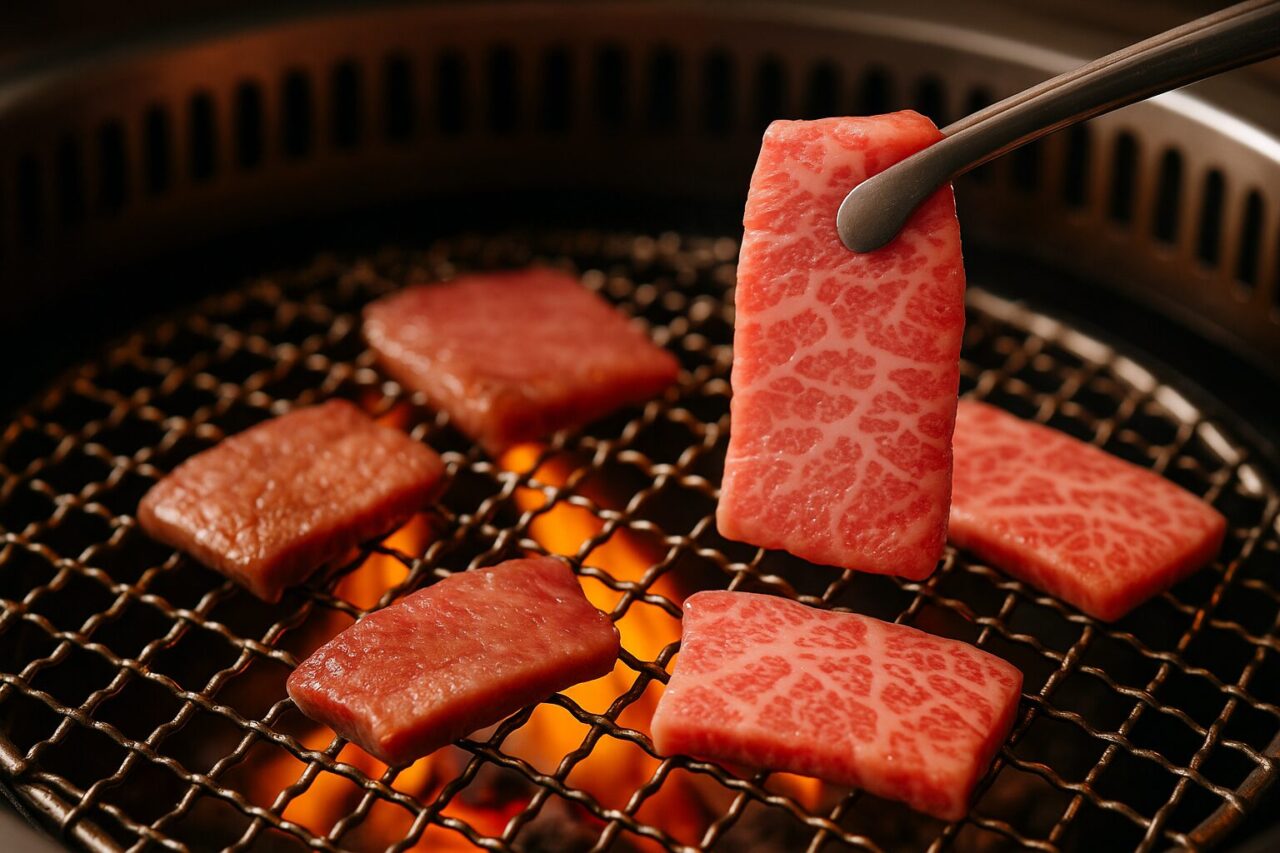
When international visitors think of Japanese meat, wagyu often comes first. Kobe beef cooked on a teppan, slices of marbled beef in sukiyaki, and shabu-shabu dipped briefly into hot broth are all experiences worth seeking out.
But they represent only the top end of a much larger food culture.
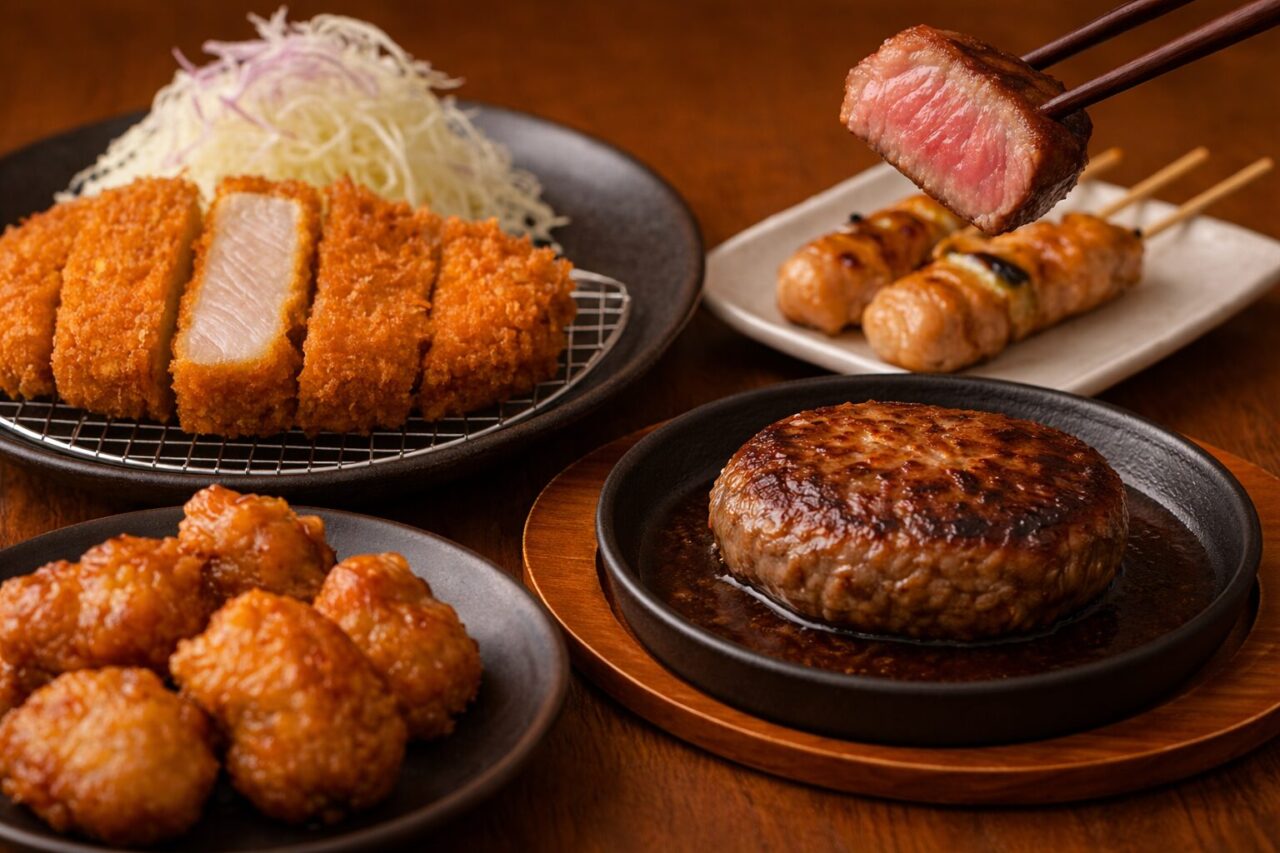
Japan also has ginger pork made with inexpensive slices, juicy karaage, minced-meat gyoza, chicken-skin yakitori, slowly simmered beef tendon and grilled offal. These are not disappointing substitutes for wagyu. Each has become a dish that people choose because they genuinely want to eat it.
Meat remained scarce and expensive for much of Japanese history, so cooks found uses for different cuts and parts. Those dishes survived after living standards improved because they tasted good. And because meat was special, people kept finding ways to make even an ordinary packet of pork or chicken worth looking forward to.
That combination helps explain why Japanese meat cooking is so diverse: it does not reserve good flavor for expensive meat.
Rather than choosing only by animal, it helps to decide what kind of experience you want.
| If you want to experience… | Try… | What makes it distinctive |
|---|---|---|
| Premium Japanese beef | Wagyu steak, teppanyaki, sukiyaki | The texture, aroma and sweetness of the fat remain central |
| A complete Japanese set meal | Tonkatsu, ginger pork, chicken nanban | Meat is balanced with rice, soup, vegetables, pickles and condiments |
| Casual food loved across Japan | Karaage, yakitori, gyoza, gyudon | Familiar dishes built for everyday satisfaction rather than ceremony |
| A shared meal | Yakiniku, sukiyaki, shabu-shabu, motsunabe | Diners cook or serve small portions from a common grill or pot |
| Japan’s use of different cuts | Yakitori, horumon-yaki, motsuni, beef-tendon stew | Skin, cartilage, organs and tendon are treated as ingredients with their own appeal |
| Regional and home-style variation | Chicken nanban, tebasaki, jingisukan, Japanese curry | Local tastes and household habits change the meat, seasoning and cooking method |
You do not need to eat every category. One premium meal, one ordinary set meal and one dish made from an unfamiliar cut will reveal more about Japanese meat culture than wagyu alone.
Buddhist influence and repeated prohibitions created a long public convention against eating the meat of certain animals. In 675, Emperor Tenmu prohibited the consumption of cattle, horses, dogs, monkeys and chickens during part of the year.
That does not mean nobody in premodern Japan ate meat. Birds, wild boar and deer continued to be eaten, and meat was sometimes presented as kusurigui—food taken for health or medicinal reasons. Japan’s tradition of Buddhist vegetarian cuisine known as shojin ryori developed alongside, rather than as proof of, a completely meat-free society.
The distance also differed by animal. Wild boar and birds were more accessible than cattle. Cattle and horses were valuable working animals used for farming and transport, making beef especially remote from the lives of most ordinary people.
After the Meiji Restoration began in 1868, the government promoted meat eating as part of modernization. Beef hot pot became fashionable in cities. Strong seasoning based on miso or soy sauce helped make an unfamiliar ingredient taste at home beside rice.
Yet legalization and fashion did not put meat on every table. Beef remained expensive, urban consumption differed from rural life, and many households continued to live with limited side dishes. Meat became an everyday food only gradually, especially as incomes and domestic production rose after World War II.
This long distance matters. For generations, eating meat carried more anticipation than opening an ordinary bag of vegetables. Even after meat became accessible, the expectation that it should deliver real satisfaction remained.
Japan’s Ministry of Agriculture, Forestry and Fisheries publishes long-term Food Balance Sheet data. The graph below compares the annual per-capita net food supply of beef, pork and chicken at selected points from 1960 to 2022.
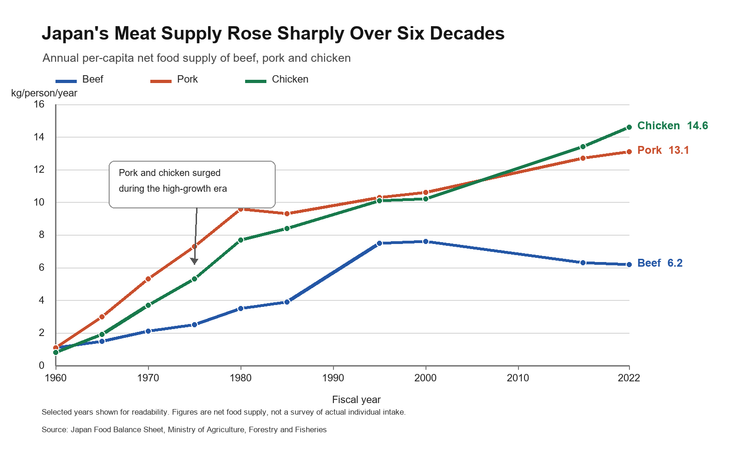
Net food supply estimates the amount available for human consumption after normally inedible or discarded portions are removed. It is not a survey of exactly what each person ate. Changes in statistical standards also mean that the full series should be read as a broad trend rather than a perfectly continuous measure. Source: Japan Food Balance Sheet, Ministry of Agriculture, Forestry and Fisheries.
In fiscal 1960, annual supply per person was approximately 1.1 kilograms of beef, 1.1 kilograms of pork and 0.8 kilograms of chicken. By 1980, it had reached 3.5 kilograms of beef, 9.6 kilograms of pork and 7.7 kilograms of chicken.
Pork gained a major place at the postwar table before chicken became today’s volume leader. Japanese meat consumption did not simply rise as a single category. Households learned different uses for each meat as availability and prices changed.
Beef supply reached 7.5 kilograms per person in 1995 and 7.6 kilograms in 2000, but stood at 6.2 kilograms in 2022. Pork reached 13.1 kilograms and chicken 14.6 kilograms in the same year.
Long periods of weak household purchasing power after Japan’s asset-price bubble are difficult to separate from this shift toward affordable pork and chicken. Health preferences, ease of cooking and the growth of prepared foods and restaurants also matter. The important point is that Japanese people did not abandon meat. They increasingly chose meats that could be eaten regularly—and already had a large repertoire of satisfying dishes waiting for them.
In a high-end wagyu steak or teppanyaki meal, the meat itself is the event. Fine texture, aroma, tenderness and richly flavored fat require relatively little disguise.
Sukiyaki and shabu-shabu express luxury differently from a thick Western steak. Excellent beef is sliced thinly, cooked quickly and shared. In sukiyaki, diners commonly dip the cooked beef into raw egg; the practice makes more sense when understood within Japan’s broader culture of eating raw eggs.
Most households do not cook premium beef every day. They buy sliced pork, chicken breast or thigh, minced meat and mixed offcuts because these are affordable and flexible.
The treatment can be simple:
Small pieces of pork can be stir-fried with onions and ginger sauce. Chicken breast can be cut diagonally and coated so it retains moisture. Minced meat can be kneaded with seasoning and other ingredients to become gyoza, tsukune or hamburg steak.
These techniques do not try to make inexpensive meat impersonate wagyu. They make the ingredient taste good as the dish it has become.
For much of Japanese history, ordinary life did not allow edible parts to be discarded casually. Economic necessity helped create ways to use skin, bones, tendon and organs.
Necessity alone, however, cannot explain why the dishes remain popular today.
Chicken skin becomes fragrant and crisp over charcoal. Cartilage has a crunch unavailable in breast or thigh. Beef tendon releases gelatin and flavor during a long simmer. Offal differs dramatically by organ in fat, chew and aroma. These parts remained on menus because people came to enjoy what made them different.
At a yakitori restaurant, ordering kawa for skin or sunagimo for gizzard is not an act of sacrifice. At a yakiniku restaurant, some diners go specifically for horumon. Japan did not merely find somewhere to hide these parts; it developed recognizable dishes around them.
The following table is not a ranking or an exhaustive catalogue. It shows how the physical character of an ingredient often points toward a particular cooking solution.
| Meat or cut | Cooking challenge | Common Japanese approach | Representative dishes |
|---|---|---|---|
| Chicken breast | Can dry out when overcooked | Diagonal slicing, seasoning, starch or batter | Toriten, chicken nanban, karaage |
| Chicken skin, cartilage and gizzard | Fat, firmness or distinctive texture | Cut small, skewer and grill, or fry | Yakitori, skin with ponzu, fried cartilage |
| Thin or irregular pork pieces | Pieces vary in size and cut | Stir-fry with vegetables and coat in sauce | Ginger pork, meat-and-vegetable stir-fry, tonjiru |
| Pork belly | High fat content | Slice thinly, simmer slowly or pair with vegetables | Kakuni, pork and daikon, hot pot |
| Minced meat | Has no intact cut or shape | Knead, season, shape or mix with other ingredients | Gyoza, hamburg steak, tsukune, soboro, menchi-katsu |
| Beef tendon | Tough connective tissue | Blanch and simmer for a long time | Beef-tendon stew, oden, tendon curry |
| Offal | Strong aroma and varied texture | Careful cleaning, blanching, miso, tare and aromatic vegetables | Motsuni, motsunabe, horumon-yaki |
| Bones | Little meat that can be eaten directly | Extract flavor through long cooking | Tonkotsu ramen, chicken paitan, mizutaki |
Cultures around the world use organs, skin, blood and bones. Japan is not unique in eating the whole animal. What is notable is how widely these approaches remain visible across home cooking, set-meal restaurants, izakaya and specialist shops.
There is no single historical explanation for why Japanese diners place such a high value on tenderness and juiciness. The preference itself, however, is easy to observe. Descriptions such as yawarakai—soft or tender—juicy, and sweet fat are routinely used as praise.
Many Japanese preparations can be understood as different ways of reaching that result.
Sukiyaki, shabu-shabu, gyudon and ginger pork use thin meat. It is easier to bite, cooks quickly and catches broth or sauce across a large surface.
Yakitori and karaage divide meat into bite-size pieces. Gyoza, tsukune, soboro and hamburg steak mince it completely. Changing the shape makes firmer pieces easier to eat and creates textures that an intact cut cannot provide.
Karaage, chicken nanban, menchi-katsu and tonkatsu use a coating to create a crisp exterior while helping the meat remain moist. A thick pork cutlet that is tender inside and surrounded by a light panko crust can surprise travelers accustomed to firmer pork dishes. Our guide to how tonkatsu became a Japanese dish explains how Japan rebuilt a Western cutlet around this contrast, rice and an entire set meal.
Kakuni, beef-tendon stew, motsuni and simmered chicken wings use time instead of tenderness at the butcher’s counter. Connective tissue softens, fat enters the broth and the cooking liquid becomes as important as the meat.
The goal is not always delicacy. Cartilage and gizzard are valued precisely because some chew remains. Japanese meat culture pursues a pleasing texture, not one universal softness.
Ginger pork, oyakodon, gyudon, karaage and hamburg steak are familiar everyday meals. They do not rely on serving an enormous amount of meat by itself.
Egg, onion, cabbage and other vegetables extend the dish without making it feel empty. Sauce, stock or a crisp coating connects the meat to rice. Soup and pickles change the rhythm of the meal. An affordable portion becomes a complete lunch or dinner.
Japanese curry belongs to the same everyday landscape. The meat may be beef, pork or chicken depending on the household and region, while katsu curry turns a cutlet into part of a larger comfort-food meal. The regional and home-style variety of Japanese curry shows how difficult it is to reduce even one familiar category to a single national recipe.
Meat is not Japan’s only celebration food. A family gathering may bring to mind a large tray of sushi before anything else, and sashimi, eel or crab can also mark a special day.
When a family chooses meat, however, it may buy better beef than usual and serve it as yakiniku, sukiyaki or shabu-shabu. Thin slices or bite-size pieces cook quickly at the center of the table. Everyone can take the amount they want, and vegetables, tofu and noodles can share the same grill or pot.
The luxury lies in both the quality of the meat and the ease of enjoying it together. This style belongs to Japan’s wider nabe and communal hot-pot culture, in which cooking remains part of the meal rather than disappearing into the kitchen.
Japan has long had steak and roast beef, but many familiar meat dishes use thin slices, mince, skewers or bite-size pieces. Sukiyaki, shabu-shabu, yakiniku and yakitori all divide the meat before or during the meal.
That made the later popularity of dry-aged beef, thick steaks, meat bars and churrasco visually striking. A large cut arriving with its original shape intact suggested a kind of abundance that traditional Japanese meat dishes rarely displayed.
By the 2010s, aged beef and dramatic thick-cut steaks had become conspicuous restaurant trends. The attraction was not only a new flavor. A diner could look at the slab and think: Are we really going to eat that much meat?
These newer experiences did not replace older ones. A person might eat karaage or ginger pork during the week, share sukiyaki with family, and choose a thick steak for a special night out. Japanese meat culture expanded by adding another idea of luxury to those it already had.
A thick pork cutlet in a light panko crust, commonly served with shredded cabbage, rice, miso soup and pickles. It demonstrates how frying technique, sauce, mustard and the structure of a set meal can make pork feel both substantial and balanced.
Chicken is seasoned before frying, often with soy sauce, ginger and garlic. Potato starch or flour creates a crisp surface while the interior remains juicy. Convenience stores sell it, households cook it, and specialists still find room to refine it.
Yakitori is best understood by ordering several skewers rather than only chicken thigh. Breast, thigh, skin, liver, gizzard, heart, cartilage and tail each offer a different balance of fat, chew and aroma.
Thin pork cooked with a sweet-savory ginger sauce is a standard set meal and home dish. It shows how sliced meat, onion, cabbage and rice can create satisfaction without an expensive cut.
Both use minced meat, but they lead in different directions. Gyoza encloses seasoned pork and vegetables in a thin wrapper, while Japanese hamburg steak is soft, juicy and commonly served with rice and sauce. Neither feels like a lesser way to eat meat.
These dishes reveal how organ meats became distinct restaurant choices. Motsuni simmers offal with miso or soy-based seasoning. Motsunabe cooks it with vegetables in a shared pot. Horumon-yaki brings individual pieces to the grill.
Originating in Miyazaki, fried chicken is dipped in a sweet-and-sour sauce and commonly served with tartar sauce. It is rich, tangy and very different from plain fried chicken.
Rice bowls turn meat, egg, onion and sauce into quick complete meals. They are especially useful for travelers who want to understand what an ordinary, affordable Japanese lunch can taste like.
If wagyu is important to you, eat it. Teppanyaki gives the cook close control over the meat, while sukiyaki or shabu-shabu shows how Japanese luxury can be thinly sliced and shared. Choose a reputable restaurant and pay attention to the stated origin or grade rather than assuming every menu using the word “wagyu” offers the same experience.
Visit a tonkatsu chain, gyudon shop, neighborhood Chinese-Japanese restaurant, izakaya or set-meal restaurant. The point is not to find the cheapest possible food. It is to see the level of preparation Japan considers normal at an everyday price.
This is also why ordinary food becomes part of the travel experience in Japan. A butcher-shop croquette, a lunch set or a convenience-store snack can be memorable without pretending to be fine dining.
At yakitori, add chicken skin, gizzard or cartilage to a familiar thigh skewer. At yakiniku, try one carefully selected type of horumon. In a winter izakaya, consider motsuni or motsunabe.
You do not have to enjoy every texture. The purpose is to experience the fact that Japanese menus distinguish these parts instead of grouping them together as waste or anonymous offal.
A good specialist may recommend salt for a particular pork, tare for one skewer and simple seasoning for another. A set-meal chain may reveal why cabbage, soup and rice matter as much as the cutlet alone. A shared hot pot asks diners to watch the heat and serve one another.
There is no need to perform expertise by eating the first bite plain or memorizing every cut. Begin with the restaurant’s recommendation and notice what the complete dish is designed to do.
Wagyu deserves its reputation, but it cannot explain Japanese meat culture by itself.
Meat remained precious for a long time, so different cuts and parts found their way into cooking. Those dishes did not survive merely because wasting food was once unaffordable. They survived because crisp chicken skin, slowly simmered tendon, juicy minced meat and pork coated in ginger sauce were genuinely good to eat.
At the same time, Japanese cooks kept pursuing tenderness, juiciness and a satisfying relationship with rice. They sliced meat thinly, minced it, coated it, skewered it, simmered it and paired it with vegetables, soup and condiments. High-priced beef and an inexpensive packet of chicken did not need to produce the same pleasure, but both were expected to produce one.
That is the breadth visitors miss when they eat only Kobe beef. Wagyu may be the peak of Japanese meat, but the landscape below it—tonkatsu, karaage, yakitori, ginger pork, gyoza, hot pots, rice bowls and organ dishes—is where Japan’s everyday appetite becomes visible.
Widely familiar dishes include yakiniku, sukiyaki, shabu-shabu, tonkatsu, karaage, yakitori, gyudon, oyakodon, hamburg steak, gyoza and ginger pork. Popularity varies by context: some are home meals, some are quick lunches, and others are shared on special occasions.
No. Wagyu is culturally important and highly visible to visitors, but pork and chicken are supplied in much larger quantities than beef in present-day Japan. Everyday meals commonly use sliced pork, chicken thigh or breast, and minced meat.
Thin meat cooks quickly, is easier to bite, catches sauce or broth and is easy to share in dishes such as sukiyaki and shabu-shabu. Thin slicing can also make a smaller amount of good meat work across a complete meal without treating it as inferior.
Yes. Common examples include horumon-yaki, motsuni and motsunabe. Yakitori shops also distinguish liver, heart, gizzard, skin and other parts as separate skewers with different textures and flavors.
If possible, choose three different experiences: one premium wagyu meal, one everyday dish such as tonkatsu or karaage, and one meal that introduces unfamiliar cuts, such as yakitori or horumon. Together they show more of Japanese meat culture than a single famous dish.