Post-Japan Depression and JPSD: Why You Miss Japan After Coming Home
CoCoRo編集部
CoCoRo

Want to summon Japanese people on social media? Show them food they have never seen before.
A recent joke on X claimed that the easiest way to attract Japanese users was to post a delicious-looking dish from your country and tell them, “You Japanese people probably don’t know this food.”
It worked.
People began sharing foods from India, South Korea, Nepal and elsewhere. Japanese users appeared in the replies asking what the dishes tasted like, how they were made and where they could try them. The joke became funnier each time another group of Japanese people was successfully “summoned” by food.
As a Japanese person, I did not find the meme insulting.
If someone posts food simply to mock Japanese people, that is a different matter. But if people proudly show us a dish they love in their own country, my first reaction would probably be gratitude.
Thank you for showing me something delicious that I did not know existed.
I would want to know what it tastes like, what ingredients are used and whether I could find it in Japan. Judging by the response to the meme, many Japanese users felt the same way.
This curiosity may explain more about Japanese food culture than the usual descriptions of sushi, rice, miso soup and seasonal ingredients.
Japan did not create its remarkably diverse food culture by protecting it from foreign influence. It created that diversity by welcoming unfamiliar food, pursuing better taste with extraordinary persistence and passing the results to the next generation.
That open, constantly evolving culture is what this article calls Washoku.
The X trend about summoning Japanese people with food was funny because many people recognized something true in it.
When Japanese users encounter an unfamiliar dish, a common response is not, “That is foreign, so it has nothing to do with us.” It is more likely to be:
Sharing a beloved dish can feel less like bait and more like an invitation.
It says, “This is something our country finds delicious. Would you like to know about it?”
The Japanese replies say, “Yes. Thank you for showing us.”
Food allows people who do not share a language, history or religion to begin a conversation with the simplest possible question: Is it good?
That response—“It looks delicious; I want to try it”—may also be the first step in the long process through which foreign food becomes part of Japanese food culture.
When people overseas picture Japanese cuisine, they may first think of sushi, tempura, miso soup or an elegant multi-course meal.
Those are important parts of Japanese food culture. Kaiseki shows how Japanese chefs use season, tableware, timing and technique to build an entire dining experience.
But everyday Japanese food is much wider.
It includes curry rice, ramen, gyoza, omurice, Napolitan spaghetti, karaage, cream stew, hamburger steak, Japanese bread, convenience-store onigiri and countless dishes influenced by other countries.
Japanese people do not spend every meal asking whether each dish is traditionally Japanese. Curry can appear beside miso soup. Gyoza can be eaten with rice. A bento may contain grilled salmon, a rolled omelet, spaghetti and fried chicken in the same box.
Karaage is now a familiar home, bento and izakaya food, regardless of the outside influences behind its history. Japanese curry has developed into home-style, school-lunch, regional and specialist-restaurant versions.
Traditional and imported, formal and casual, regional and industrialized foods do not live in separate worlds. They meet on the same Japanese table.
Japan has borrowed ingredients, techniques and dishes from abroad for centuries. But “borrowed” does not mean “copied without change.”
Once a dish attracts attention, Japanese cooks, families, restaurants and food companies begin asking questions.
Would it taste better with Japanese rice? Could it be made softer, crispier or less sweet? Would a different sauce make it easier to eat at home? Can it be sold in a bento? Could it become a seasonal dish? Can a local region create its own version?
One imported idea can eventually become dozens of Japanese variations.
Tempura was shaped by contact with foreign cooking, yet its batter, ingredients, dipping sauce, restaurant culture and specialist craft developed in Japan.
Today it is difficult to tell the story of Japanese cuisine without it. The history of tempura shows how an outside influence became one of Japan’s most recognizable foods.
The history of noodles in Japan also includes influence from the Asian continent. Yet udon did not remain one standardized imported food.
Different regions developed their own noodle thickness, texture, broth, toppings and ways of serving it. Sanuki, Inaniwa and other forms of udon reflect local climate, ingredients and knowledge.
Hiyashi chuka literally contains the word “Chinese,” but the cold noodle dish developed in Japan. It was shaped by Japanese summers, restaurant needs, colorful seasonal ingredients and the annual pleasure of seeing signs announcing its return.
Hiyashi chuka is now part of the rhythm of the Japanese summer. Its name remembers outside influence while the dish itself belongs to life in Japan.
Tuna mixed with mayonnaise was already familiar in Western food. Japan placed that creamy filling inside rice and wrapped it in nori.
Tuna mayo onigiri spread through convenience stores and later influenced home cooking. What began as a meeting between an American-style flavor and a Japanese rice ball became one of Japan’s most familiar onigiri fillings.
This is not simply fusion for novelty. It is a repeated process of making unfamiliar food useful, comforting and delicious within Japanese life.
I have not tried many unfamiliar dishes recently, but I still remember my first Shkmeruli, a Georgian chicken dish with a powerful garlic sauce.
My very Japanese first reaction was: “Isn’t this basically white stew?”
That did not make the dish less interesting. It made it easier to understand—and easier to love.
The garlic was much stronger than the Japanese cream stew I knew, but the warm, creamy sauce and chicken also felt comforting. I immediately understood why Japanese diners had embraced it.
Shkmeruli was introduced by a major Japanese restaurant chain, became popular enough to return repeatedly and inspired other ready-to-eat products and adaptations. A dish that had been unfamiliar to most Japanese people began accumulating memories in Japan.
This is an important part of how people approach foreign food.
Japanese diners may compare a new dish with something they already know:
The comparison does not erase the original culture. It gives people a foothold from which they can appreciate the difference.
“I know something a little like this” is often followed by “Now I want to taste what makes this one different.”
Shkmeruli has not been passed down in Japan for generations in the way that curry or ramen has. That is precisely why it is an interesting example. We may be watching an unfamiliar foreign dish begin its journey into Japanese food culture.
Curiosity explains why Japanese people try unfamiliar food. It does not fully explain what happens next.
Once Japanese people love a dish, someone begins trying to make it better.
Ramen becomes divided by broth, noodle, region, cooking method and school of thought. Curry becomes home curry, school curry, naval curry, soup curry, regional curry and specialist curry. Bread becomes sweet bread, savory bread, soft shokupan and local bakery specialties.
Even familiar foods are constantly adjusted through limited editions, regional ingredients, new textures and competing restaurant styles.
In Japan, discovering a delicious dish is often not the end of the story. It is the beginning of improvement.
Calling this an “obsession” is not much of an exaggeration.
At first glance, soba is only noodles and dipping sauce. Yet specialists pursue differences in buckwheat flour, flour ratios, water, kneading, cutting, boiling and broth.
Dashi may look simpler than a heavily seasoned sauce, but small choices change it: kombu, katsuobushi, niboshi, dried shiitake, water temperature and extraction time.
Miso is used throughout Japan, yet its ingredients, color, sweetness, saltiness and aroma differ by region.
Japan’s miso culture is both nationally familiar and locally diverse. Japanese food often becomes richer not by choosing one correct version, but by allowing many versions to grow.
Japanese food cannot be defined only by birthplace.
If foreign origin automatically disqualified a dish, tempura, many noodles and much of modern Japanese home cooking would become difficult to explain.
I find a simpler definition more useful:
Washoku is food that Japanese people have loved, shaped and passed down.
| Process | What it means | What it looks like in everyday life |
|---|---|---|
| Loved | People choose the dish repeatedly until it becomes familiar | It appears at home, school, restaurants, shops and celebrations |
| Shaped | The dish changes to suit Japanese ingredients, tastes and habits | It is paired with rice, given new textures, regional styles or convenient forms |
| Passed down | Families, chefs, regions and companies carry it forward | The next generation receives it as a familiar part of Japanese life |
This process does not always take place in traditional kitchens.
Convenience stores develop new fillings. Food companies make restaurant flavors available at home. School lunches introduce children to dishes that later become nostalgic. Families simplify recipes. Regional restaurants create local identities.
Onigiri can absorb new fillings while remaining recognizably Japanese. Bento carries old and new foods together in one compact meal. Japanese bakeries turned imported bread culture into an enormous range of sweet and savory creations.
Japan does not merely preserve recipes. It preserves the habit of adapting food to life.
The following table applies the “loved, shaped and passed down” idea to foods with different histories.
This is not an official legal classification. It is a way to understand why foods with foreign roots can come to feel unmistakably Japanese.
| Dish | Outside influence | How Japan shaped it | How it became part of Japanese life | Where it stands today |
|---|---|---|---|---|
| Tempura | European frying traditions | Batter, ingredients, dipping sauce and specialist service developed in Japan | From Edo street food to homes and fine dining | A representative Washoku dish |
| Udon | Continental noodle culture | Regional noodles, broths and serving styles developed across Japan | Everyday meals and regional specialties | A representative Washoku dish |
| Japanese curry | India via Britain | A thicker sauce designed around Japanese rice and local tastes | Homes, schools, the military, restaurants and regional tourism | A multigenerational Japanese staple |
| Ramen | Chinese noodle traditions | Broths, noodles, toppings, shops and regional schools evolved independently | A national everyday food with powerful local identities | Japanese food with its own global identity |
| Omurice | Western-style cooking | Rice, egg, sauce and presentation combined into a distinct Japanese dish | Yoshoku restaurants and home comfort food | A Japanese dish still called yoshoku |
| Gyoza | Chinese dumpling traditions | Pan-frying, thinner wrappers and pairing with rice became common | Homes, restaurants and frozen food | A familiar Japanese everyday food |
| Tuna mayo onigiri | Western tuna salad and Japanese rice-ball culture | Tuna mayonnaise was placed inside rice and wrapped in nori | Convenience stores and home cooking | A standard modern onigiri filling |
| Shkmeruli | Georgian cuisine | Introduced as a rice-friendly set meal and adapted into new Japanese products | Popular demand led to repeated returns | A foreign dish beginning to build a history in Japan |
The boundary does not disappear because Japanese people are careless about origins. It fades because food develops a second history in Japan.
The Japanese expression futokoro ga fukai literally suggests having a “deep chest” or broad inner space. It describes someone or something generous enough to accept difference without losing its identity.
Washoku has that kind of breadth.
It can contain the disciplined world of kaiseki, the plant-based traditions of Shojin Ryori, regional noodles, home curry, convenience-store onigiri and foods that arrived from abroad.
This does not mean that every dish served in Japan instantly becomes Washoku.
The important question is not simply, “Where was it born?” It is also:
The openness of Washoku is not the absence of culture. It is one of the ways Japanese culture grows.
English-language explanations often create a clean distinction:
This distinction can be useful when introducing restaurant categories. But Japanese people do not always use washoku, nihonshoku and nihon ryori as three mathematically separate collections of food.
The words carry different impressions.
| Japanese term | Common English explanation | Impression it often carries in Japan |
|---|---|---|
| Washoku(和食) | Japanese food or traditional Japanese cuisine | Tradition, seasonality, home meals and Japanese-style dining |
| Nihonshoku(日本食) | Japanese food | Often used when comparing Japanese food with the food of other countries |
| Nihon ryori(日本料理) | Japanese cuisine | Greater emphasis on culinary technique, restaurants and professional cooking |
Their meanings overlap substantially. Sushi can be Washoku, Nihonshoku and Nihon ryori depending on the sentence.
The Japanese Ministry of Agriculture, Forestry and Fisheries offers an especially interesting perspective in its English booklet, Traditional Dietary Cultures of the Japanese. It describes a typical home Washoku meal, but also explains that sushi, noodles, mochi dishes and even curry and rice can be considered forms of Washoku.
This is much broader than the common English claim that curry is Japanese food but can never be Washoku.
The term does not have to function as a border guard.
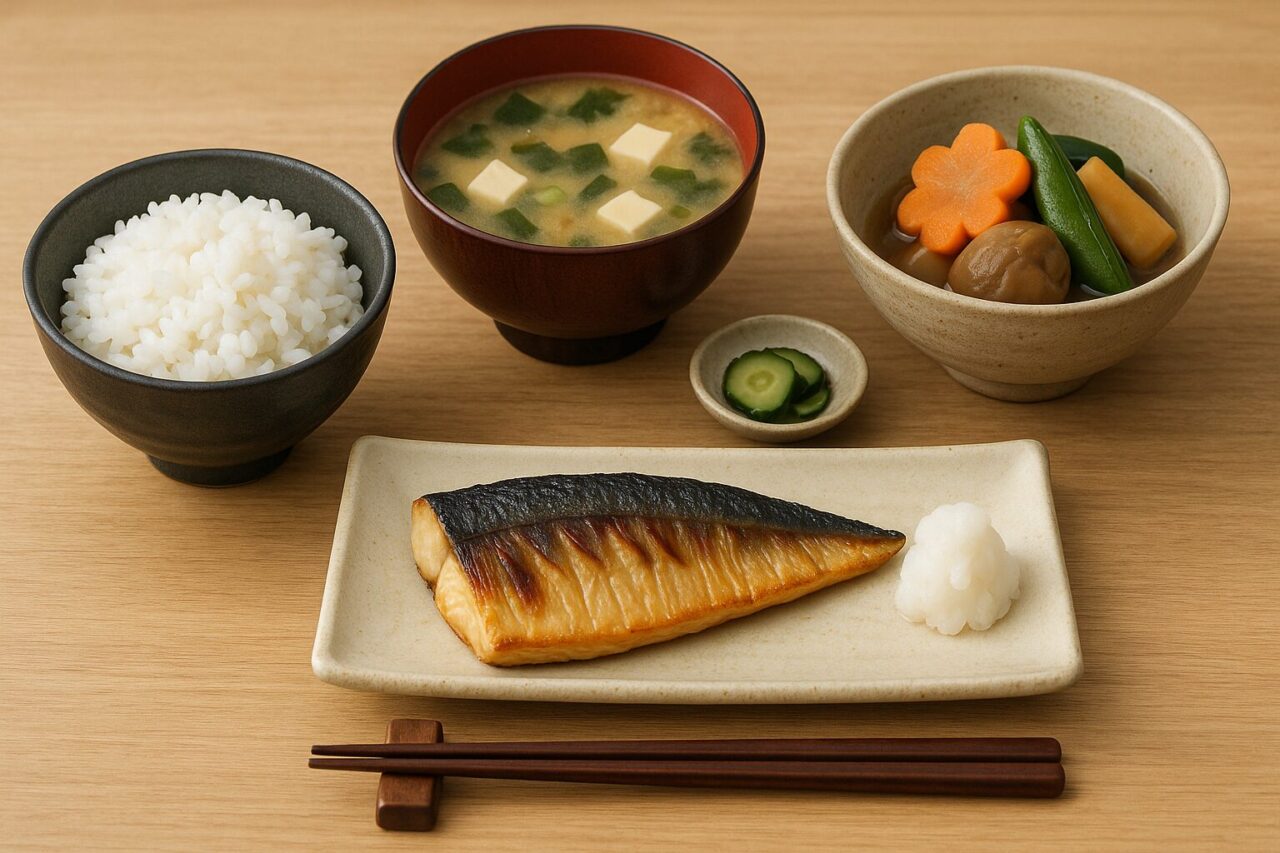
Ichiju-sansai means “one soup, three dishes.” A typical arrangement includes rice, soup, a main dish and two smaller side dishes, often accompanied by pickles.
It is one of the clearest ways to explain the balance and structure of a Japanese meal.
But it cannot define every food that belongs to Japanese culture.
Sushi is not normally eaten as one soup and three dishes. Neither are soba, udon, donburi, onigiri, wagashi or many shared hot-pot meals.
Nabe develops around one shared pot rather than a fixed set of separate dishes. Mochi belongs to Japanese culture through agriculture, New Year customs, family practices and regional foods, not because it fits an ichiju-sansai arrangement.
Ichiju-sansai is an important expression of Washoku. It is not the entrance requirement for every Japanese food.
Tradition can sound like something completed long ago and carefully stored away.
Japanese food history tells a different story.
Many dishes survived because people changed them. New ingredients were accepted. Cooking methods adapted to new homes. Restaurants created specialties. Food companies made difficult dishes convenient. Local communities built new identities around food.
What Japanese people eat today includes yesterday’s foreign influences. What they are trying today may become tomorrow’s comfort food.
Perhaps the X joke worked because it revealed this openness in its simplest form.
If you want to “summon” Japanese people, show them food they have never seen. Some may appear in the replies asking what it tastes like and where they can try it.
Not because they feel mocked, but because being shown someone’s favorite food can feel like receiving a small cultural gift.
Someone may eventually taste it. A restaurant may adapt it. Diners may compare it with something familiar. People may ask for it to return. A once-unknown dish may begin to acquire memories in Japan.
Japanese food has grown through countless encounters like this: curiosity, gratitude, adaptation, refinement and transmission.
The diversity of Japanese food did not appear despite foreign influence. It appeared because Japan welcomed foreign influence and pursued deliciousness with remarkable persistence.
That is the open spirit of Washoku.